

Uma profile

Rice Shower


Rice Shower is one of Tracen Academy's most gentle and emotionally complex Umamusume. Soft-spoken, thoughtful, and unfailingly considerate of those around her, she often worries that her presence brings misfortune rather than happiness. While others see a talented long-distance runner with extraordinary determination, Rice herself quietly carries the burden of believing she is destined to play the role of the "villain" in someone else's story.
Uma Profile
Unlike many of her classmates, Rice Shower rarely seeks attention. She prefers peaceful moments in the academy gardens, tending flowers or enjoying the quiet company of close friends. Her love of roses is especially well known, with each bloom representing her hope that even something surrounded by thorns can still bring beauty and comfort to others. Friends often describe her as surprisingly warm once she lowers her guard, revealing a gentle sense of humour hidden beneath her reserved exterior.
Rice's greatest strength lies in her unwavering determination. Once she sets herself a goal, she refuses to give up, regardless of how difficult the journey becomes. Although naturally timid, she displays remarkable courage whenever she steps onto the racetrack. Every race becomes a promise to herself that she will run honestly, giving everything she has without regret. She never races to deny someone else's dream; she races because she believes every Umamusume deserves to pursue their own.
Her relationship with her Trainer forms the emotional heart of her story. Encouraged to believe in her own worth rather than the opinions of others, Rice gradually learns that victory itself is not something to apologise for. Through patient guidance and the support of her friends, she slowly begins to understand that earning success through hard work is something to be proud of, not ashamed of.
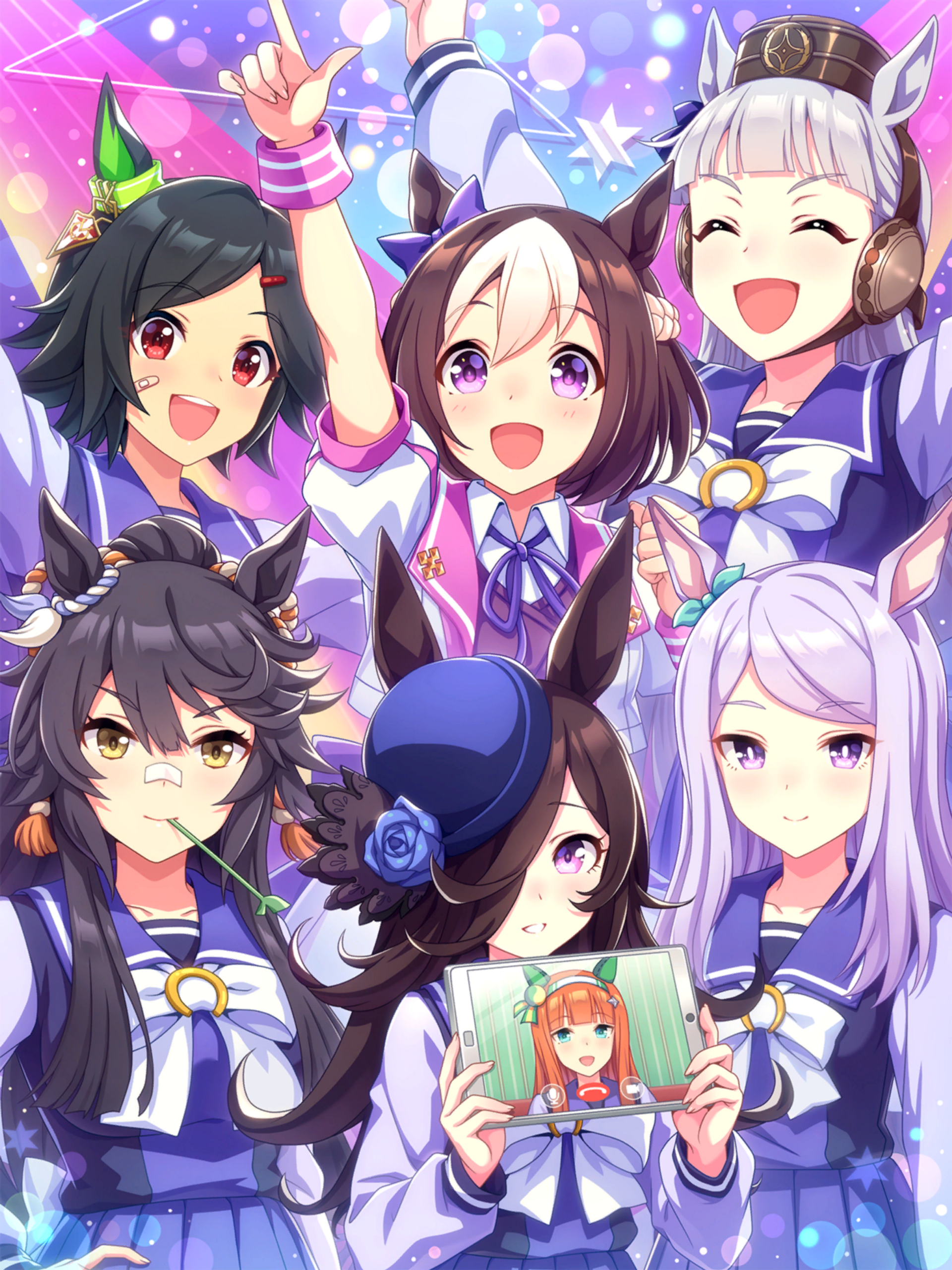
Rice Shower's greatest rivalries often become her deepest friendships. She holds immense respect for accomplished runners such as Mihono Bourbon, Mejiro McQueen, and Biwa Hayahide, seeing them not as obstacles but as inspirations that encourage her to become stronger. Every hard-fought race teaches her something new, and every defeat only strengthens her resolve to continue growing.
Although naturally quiet, Rice possesses an unexpected competitive intensity that emerges once a race begins. Her calm expression gives way to fierce concentration as she steadily closes on the leaders with her trademark stamina. Rather than relying on explosive speed, she trusts her endurance and determination, believing that every stride carries her closer to fulfilling both her own dreams and the expectations of those who support her.
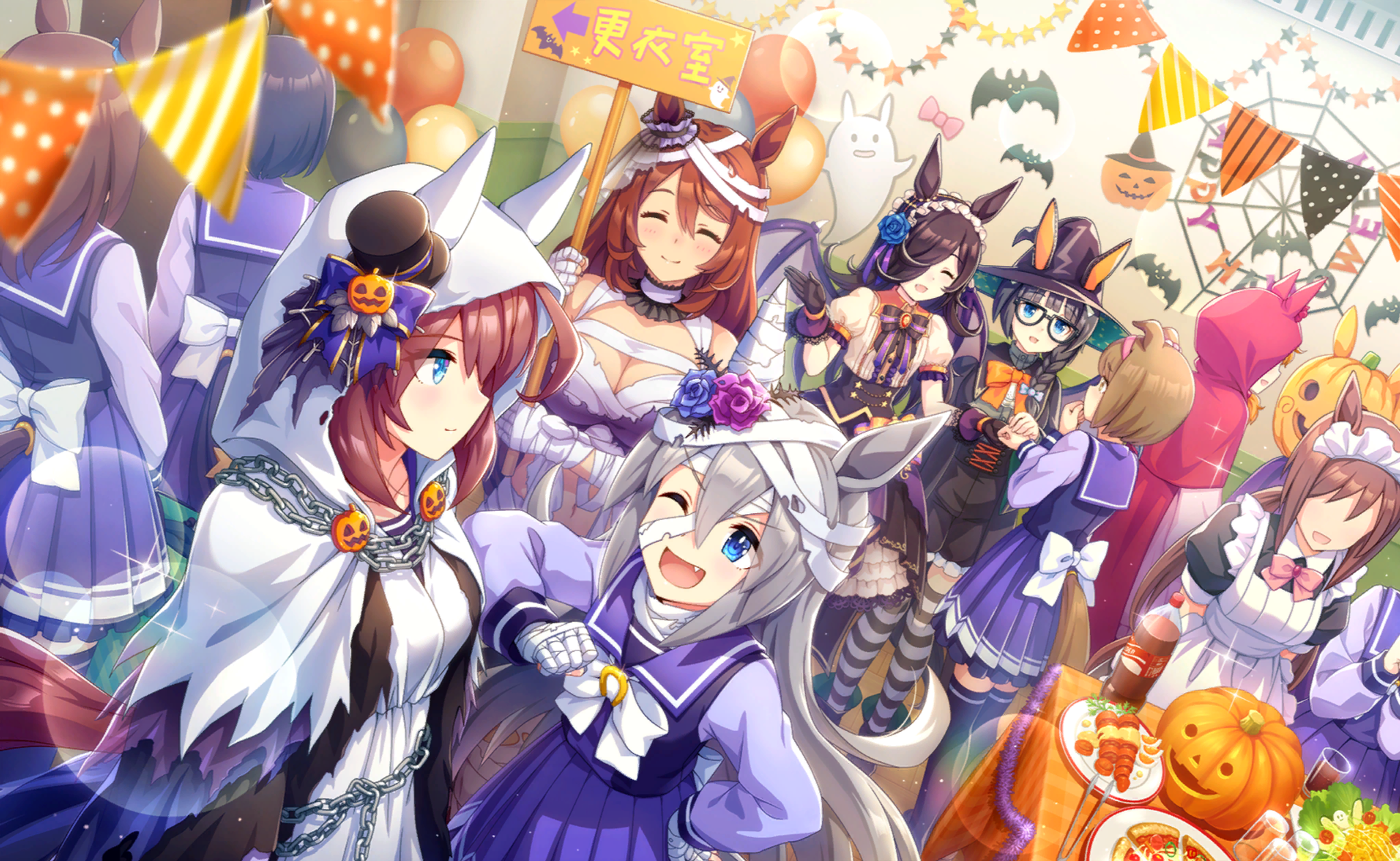
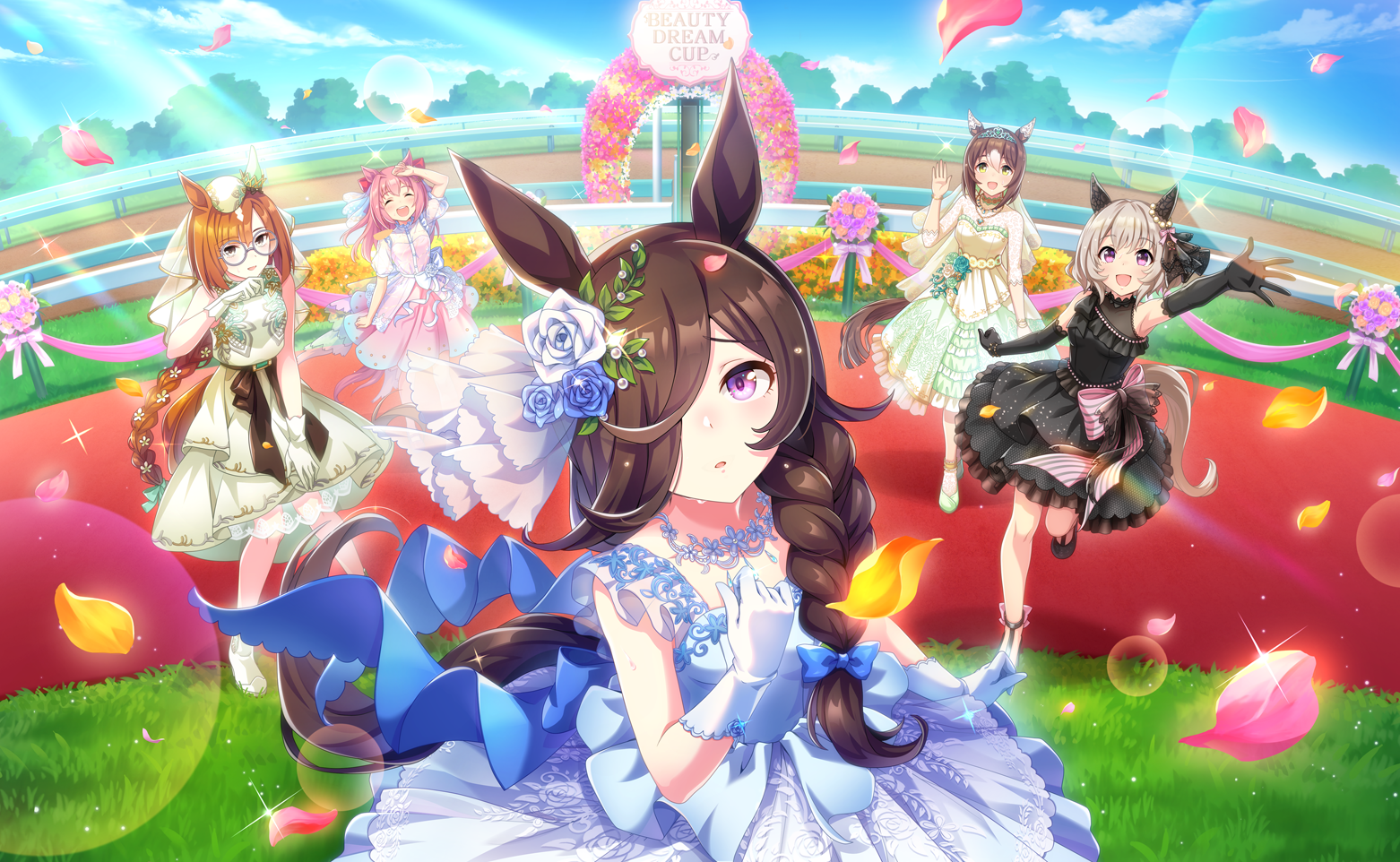
Visually, Rice Shower is instantly recognisable by her elegant dark attire, flowing dark hair, and striking violet eyes. Her gothic-inspired aesthetic reflects her reserved personality while contrasting beautifully with the warmth hidden beneath the surface. Despite her somewhat intimidating appearance, she is one of the academy's kindest and most compassionate students, often putting others before herself without hesitation.
Perhaps more than any other Umamusume, Rice Shower embodies the idea that kindness is a form of strength. Her journey is not simply about becoming a stronger runner, but about learning to forgive herself, accept the affection of those around her, and realise that she was never the villain she imagined herself to be. It is this emotional growth, alongside her unwavering perseverance, that has made Rice Shower one of the franchise's most beloved and unforgettable characters.
Personality
- Quiet and deeply considerate.
- Extremely hardworking.
- Often worries about disappointing others.
- Finds happiness in helping people.
- Stronger than she believes herself to be.
- Blossoms with encouragement and trust.
Legacy
Rice Shower has become one of the emotional centrepieces of Uma Musume: Pretty Derby. Inspired by one of Japanese racing's most bittersweet true stories, she represents perseverance, compassion, and the courage to keep moving forward even when misunderstood. Her journey from self-doubt to self-acceptance resonates deeply with fans, making her one of the series' most cherished characters. Through Rice, the legacy of the real racehorse lives on—not as the "assassin" once imagined by the public, but as a gentle soul whose greatest wish was simply to make others smile.
Sources
- https://umamusu.wiki/Rice_Shower
- https://gametora.com/umamusume/characters/100801-rice-shower
- https://umamusume.com/characters/











Touch fallback
Rice ShowerTouch and smaller layouts use grouped connection cards instead of the live radar. Open any entry to follow the relationship directly.
Same races
Same Races
13 shared rivals

Latest: ARIMA KINEN (39TH THE GRAND PRIX) · 1994-12-25

Latest: TENNO SHO (AUTUMN) · 1993-10-31

Latest: Kikuka Sho · 1992-11-08

Latest: KYOTO KINEN · 1995-02-12

Latest: NIKKEI SHO · 1994-03-20

Latest: TAKARAZUKA KINEN · 1995-06-04

Latest: TAKARAZUKA KINEN · 1995-06-04

Latest: KYOTO KINEN · 1994-02-13

Latest: JAPAN CUP (INTERNATIONAL INVITATIONAL) · 1993-11-28

Latest: TENNO SHO (AUTUMN) · 1993-10-31

Latest: TENNO SHO (SPRING) · 1993-04-25

Latest: TENNO SHO (SPRING) · 1993-04-25

Latest: G2 · 1992-03-29
Related Umas
1 total · 1 linked
Mentioned By Related Umas
3 profiles
Mentioned By Rivals
1 profile
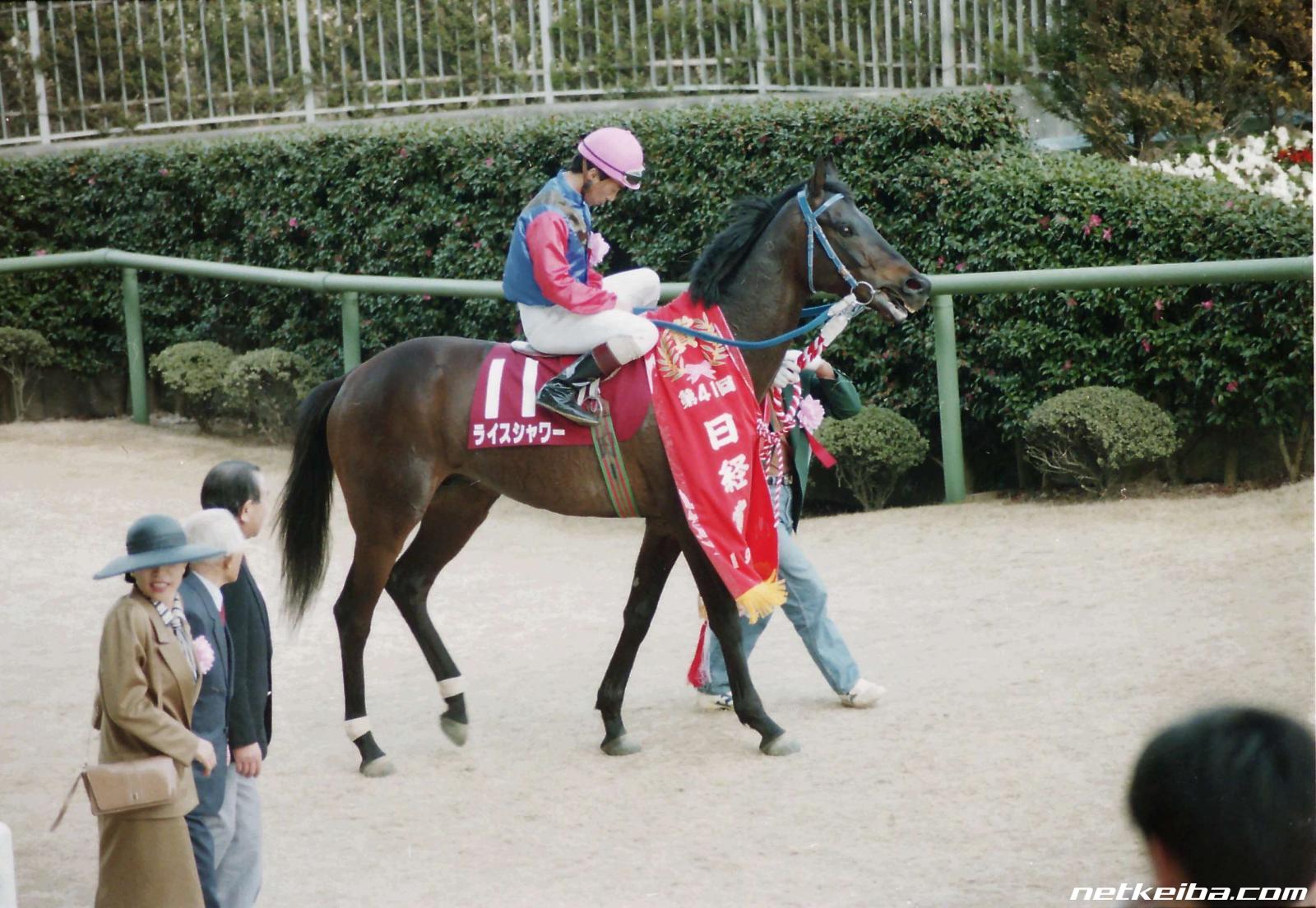
Rice Shower was a dark bay Japanese Thoroughbred whose finest performances came in the country’s most demanding long-distance races. He stopped Mihono Bourbon’s Triple Crown bid in the 1992 Kikuka Sho, won the Tenno Sho (Spring) in both 1993 and 1995, and became one of the defining stayers of early-1990s Japanese racing.
Career at a glance
Track record
Featured races
Finished 1st · G1 · at Kyoto · over 3000m · Kyoto (JP)
Finished 1st · G1 · at Kyoto · over 3200m · Kyoto (JP)
Finished 1st · G1 · at Kyoto · over 3200m · Kyoto (JP)
At a glance
Origins and pedigree
Foaled on 5 March 1989, Rice Shower was bred by Utopia Bokujo. He raced for owner Hideo Kuribayashi and was trained at Miho by Yoshiji Iizuka.
Rice Shower was by the American-bred Real Shadai, a son of Roberto and Desert Vixen. His dam, Lilac Point, was a Japanese-bred daughter of Maruzensky and Kuri Katsura. Although his first two victories came over 1,000 and 1,600 metres, that pedigree accompanied a career increasingly defined by stamina: his three Grade 1 victories were ultimately earned at 3,000 and 3,200 metres.
Career at a glance
- Foaled: 5 March 1989
- Died: 4 June 1995, aged six
- Sex: Stallion
- Colour: Dark bay
- Breeder: Utopia Bokujo
- Owner: Hideo Kuribayashi
- Trainer: Yoshiji Iizuka
- Record: 25 starts, 6 wins, 5 seconds and 2 thirds
- Earnings: ¥729,497,200
- Major wins: Kikuka Sho (1992), Nikkei Sho (1993), Tenno Sho (Spring) (1993 and 1995)
- Honour: JRA Special Award (1995)
Racing career
Early promise and the 1992 Classics
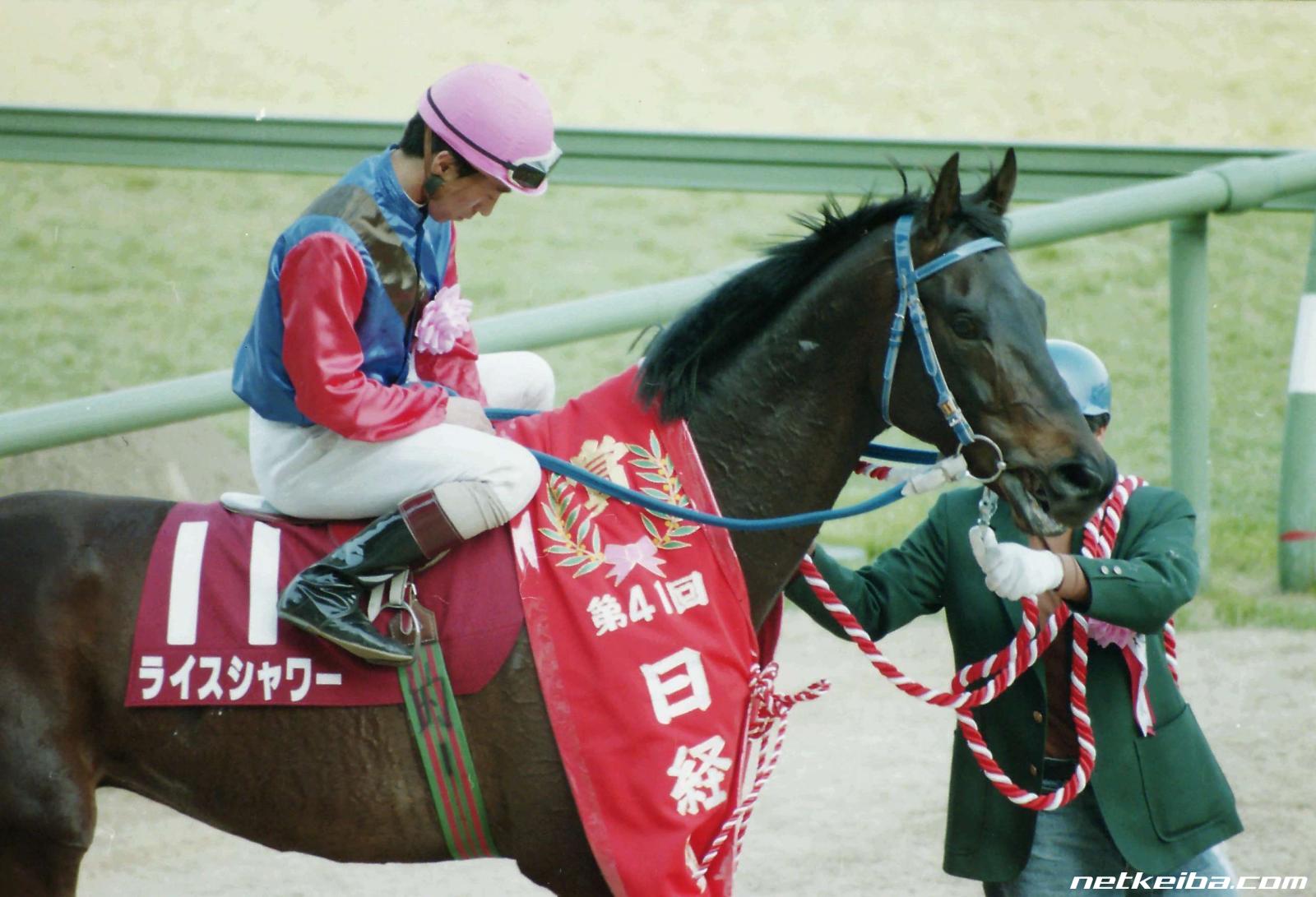
Rice Shower made a winning debut over 1,000 metres at Niigata on 10 August 1991. He finished 11th in a Grade 3 race over 1,200 metres at the same course the following month, then returned to winning form in an open race over 1,600 metres on soft ground at Nakayama.
His 1992 season began less smoothly. Rice Shower finished fourth in a Grade 2 contest over 1,800 metres and eighth in the Satsuki Sho, the first leg of Japan’s colts’ Triple Crown. Another eighth-place finish followed over 2,000 metres at Tokyo, but the longer distance of the Tokyo Yushun, or Japanese Derby, brought a marked improvement. Over 2,400 metres at Tokyo on 31 May, he finished second in an 18-runner field.
That Derby placing established Rice Shower as one of the leading members of his generation. Mihono Bourbon, however, remained the dominant figure. Having won both the Satsuki Sho and the Derby, he entered the autumn with an unbeaten record and the opportunity to complete the Triple Crown.
Rice Shower prepared for the final Classic with two further second-place finishes. He was runner-up in the 2,200-metre St. Lite Kinen at Nakayama in September and again in the Kyoto Shimbun Hai in October. The sequence showed that he was consistently competitive and increasingly effective as the distances lengthened.
Defining races
1992 Kikuka Sho: ending a Triple Crown bid
The Kikuka Sho at Kyoto on 8 November 1992 was run over 3,000 metres, making it the longest of Japan’s three colts’ Classics. Mihono Bourbon was heavily favoured to complete the Triple Crown, while Rice Shower went into the race as the distant second favourite.
Ridden by H. Matoba, Rice Shower defeated Mihono Bourbon and ended the previously unbeaten colt’s attempt to sweep the Classics. The victory was a major upset, but it also revealed the quality that would define Rice Shower’s career. After finishing second over 2,200 and 2,400 metres, he improved again when asked to compete over 3,000.
The Kikuka Sho gave him his first Grade 1 title and fixed his place in the history of his generation. His victory became inseparable from the achievement he had prevented: he was remembered not simply as a Classic winner, but as the horse who denied Mihono Bourbon the Triple Crown.
Rice Shower ended the year with an eighth-place finish in the Arima Kinen over 2,500 metres. His greatest opportunities, however, still lay ahead in Japan’s premier staying races.
1993 Tenno Sho (Spring): confirmation at 3,200 metres
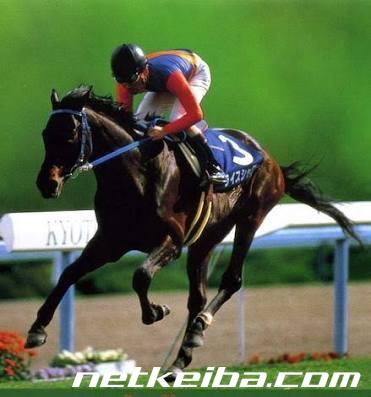
Rice Shower opened 1993 by finishing second in the Meguro Kinen over 2,500 metres at Tokyo. On 21 March he returned to the winner’s enclosure in the Nikkei Sho, a Grade 2 race over the same distance at Nakayama. That success provided an effective preparation for the longest Grade 1 assignment of his career.
On 25 April he contested the Tenno Sho (Spring) over 3,200 metres at Kyoto. Facing 14 opponents, Rice Shower won under Matoba to claim his second Grade 1 title. Coming after his 3,000-metre Kikuka Sho victory, the result showed that his Classic success had not been an isolated upset: he was one of Japan’s foremost long-distance horses.
The defeated field included Mejiro McQueen, who was seeking a third consecutive victory in the Tenno Sho (Spring). As in the Kikuka Sho, Rice Shower’s win became part of a larger historical narrative because it prevented an established champion from completing a celebrated objective. The common element in both races, however, was Rice Shower’s own excellence over extreme distances.
His results later in 1993 were mixed. He finished third in the Grade 3 All Comers at Nakayama, sixth in the Tenno Sho (Autumn), 14th in the Japan Cup and eighth in the Arima Kinen. Those races were staged over distances from 2,000 to 2,500 metres, all shorter than the two events that had established his reputation.
Setbacks and a gradual recovery
Rice Shower raced only three times in 1994. He finished fifth in the Kyoto Kinen, staged that year at Hanshin, and then returned to Nakayama to finish second in the Nikkei Sho. After a long absence, he reappeared in the Arima Kinen on 25 December and placed third in a field of 13.
That Grade 1 placing was an important sign of continuing competitiveness after a season without a victory. It also provided a foundation for one final campaign.
The opening races of 1995 did not immediately produce a return to Rice Shower’s best form. He finished sixth in the Kyoto Kinen over 2,200 metres and sixth again in the Nikkei Sho over 2,500 metres on heavy ground. His next start, however, brought him back to the course, race and distance most closely associated with his greatest strength.
1995 Tenno Sho (Spring): regaining the title by a nose
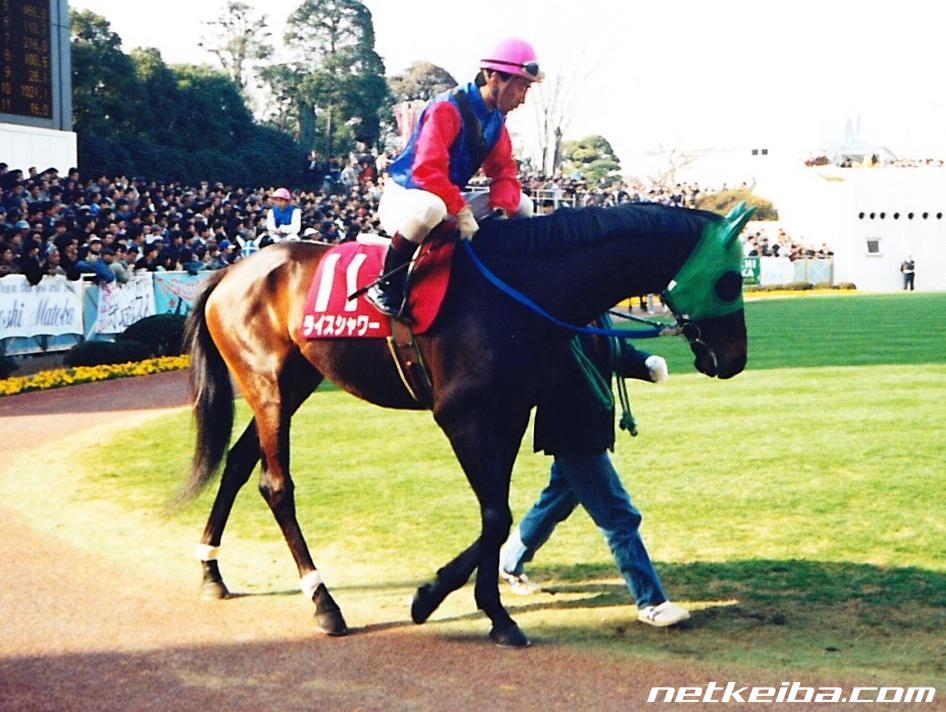
On 23 April 1995, Rice Shower returned to Kyoto for the Tenno Sho (Spring). The 3,200-metre race was run on soft ground and attracted 18 runners.
Rice Shower and Stage Champ reached the finish together. A photo finish awarded the victory to Rice Shower by a nose, giving him a second Tenno Sho (Spring) title two years after his first. It was his first victory since the 1993 running and the third Grade 1 success of his career.
The narrow result completed a notable return to the top. Rice Shower had endured uneven form during the second half of 1993, a shortened 1994 campaign and two unplaced preparatory starts in 1995. Back over 3,200 metres, he again produced the performance that marked him as an exceptional stayer.
Connections and distance profile
Rice Shower’s record traces a clear progression from early speed tests to long-distance distinction. His first victory came over 1,000 metres and his second over 1,600, but his three principal Grade 1 wins were achieved over 3,000 or 3,200 metres. He also finished second in the 2,400-metre Japanese Derby and recorded prominent placings in important races between 2,200 and 2,500 metres.
Jockey H. Matoba was the central riding figure in Rice Shower’s career. Matoba rode him in the Japanese Derby, the Kikuka Sho, both Tenno Sho (Spring) victories and most of his later major engagements. Their partnership produced the performances that defined Rice Shower’s reputation: a Classic victory over 3,000 metres and two editions of Japan’s premier 3,200-metre championship.
The contrast between Rice Shower’s results at different distances was particularly striking. He could compete at a high level over intermediate trips, as demonstrated by his Derby second and Arima Kinen third, but his greatest victories came when stamina became decisive. His three Grade 1 successes were all recorded at Kyoto, another recurring feature of his career.
Final race and legacy
Following the 1995 Tenno Sho (Spring), retirement was considered, but Rice Shower remained strongly supported by the public and was voted the leading selection for the Takarazuka Kinen. In the aftermath of the Hanshin earthquake, the race was transferred from Hanshin to Kyoto—the course where he had won all three of his Grade 1 races.
The Takarazuka Kinen was run over 2,200 metres on 4 June 1995. During the race, Rice Shower suffered a fatal fracture and was euthanised on the course. He was six years old.
His death brought an abrupt end to a career of 25 starts, six victories, five seconds and two thirds. Later in 1995, he received a JRA Special Award, following a season in which he had regained the Tenno Sho (Spring) before his fatal final appearance.
Rice Shower’s competitive legacy rests above all on three races. In the 1992 Kikuka Sho he stopped Mihono Bourbon’s Triple Crown attempt; in the 1993 Tenno Sho (Spring) he confirmed his standing among Japan’s elite stayers; and in 1995 he reclaimed that championship by the smallest possible margin. Those victories placed him at the centre of several defining moments in early-1990s Japanese racing, while the public vote that sent him to his final Takarazuka Kinen reflected the strong following he had developed.
More photographs
IRL image archive
2 more images
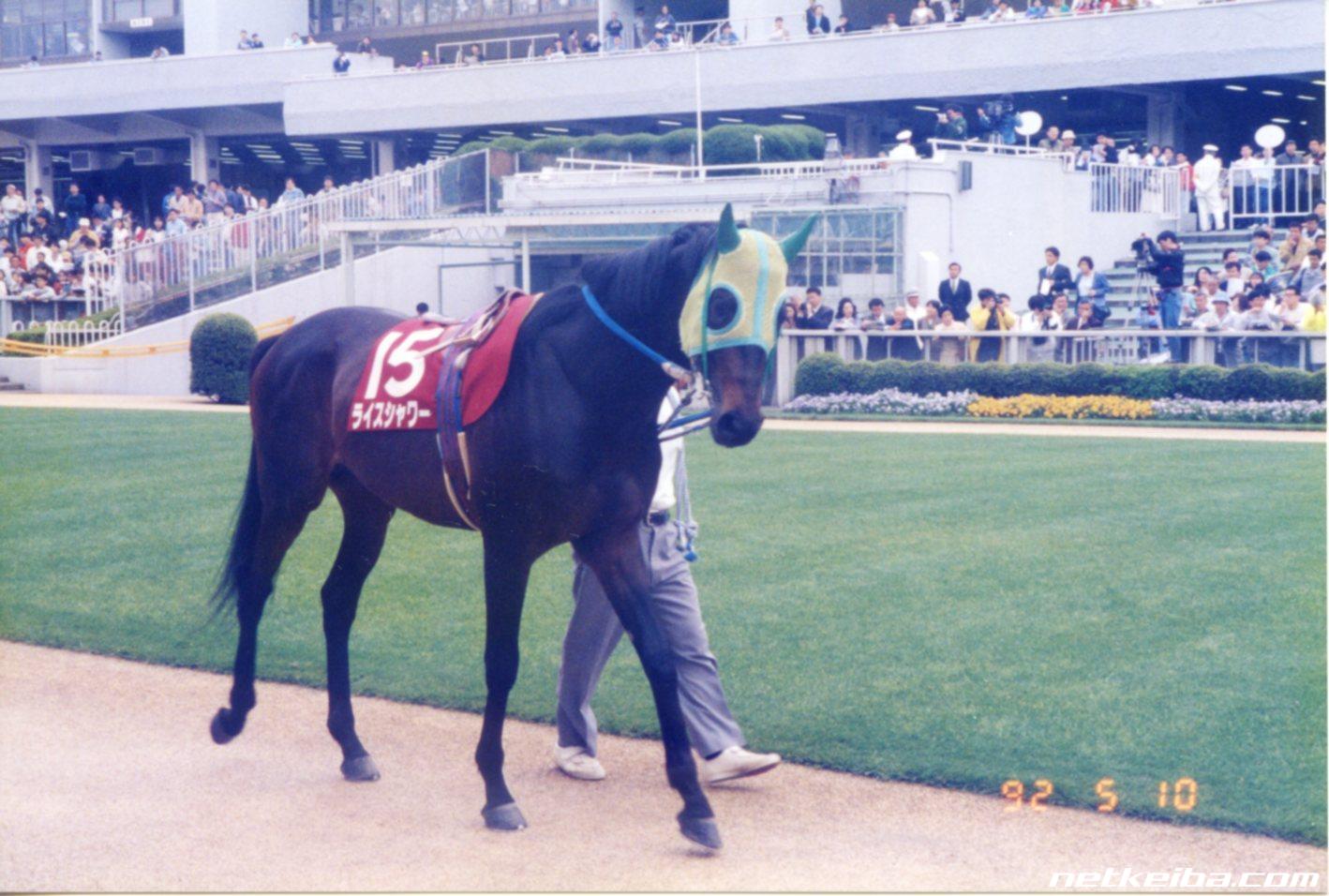
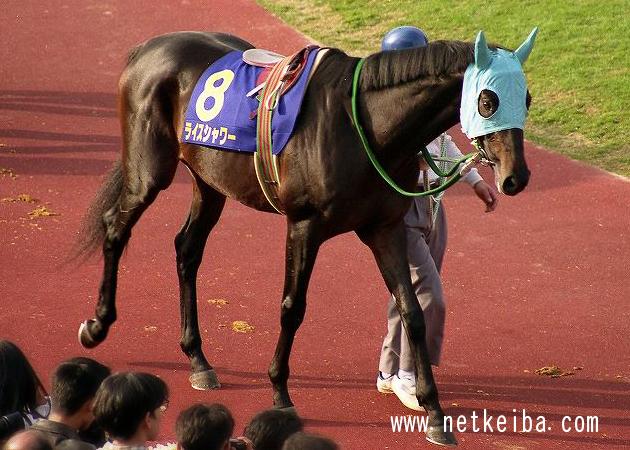
| Date | Race | Grade | Course | Going | Dist | Pos | Draw | Jockey | Wgt | SP | Time |
|---|---|---|---|---|---|---|---|---|---|---|---|
| 1995-06-04 |
TAKARAZUKA KINEN
|
G1 | Kyoto (JP) | Good to Soft | 2200 m | - | 16 | H.Matoba | 56.0 kg | 6.0 | - 0.0 |
| 1995-04-23 |
TENNO SHO (SPRING)
|
G1 | Kyoto (JP) | Soft | 3200 m | 1 | 3 | H.Matoba | 58.0 kg | 5.8 | 3:19.9 |
| 1995-03-19 |
NIKKEI SHO
|
G2 | Nakayama (JP) | Heavy | 2500 m | 6 | 1 | H.Matoba | 59.0 kg | 1.9 | 2:42.3 |
| 1995-02-12 |
KYOTO KINEN
|
G2 | Kyoto (JP) | Good | 2200 m | 6 | 8 | H.Matoba | 60.0 kg | 2.7 | 2:12.5 |
| 1994-12-25 |
ARIMA KINEN (39TH THE GRAND PRIX)
|
G1 | Nakayama (JP) | Good | 2500 m | 3 | 10 | H.Matoba | 56.0 kg | 17.7 | 2:33.1 |
| 1994-03-20 |
NIKKEI SHO
|
G2 | Nakayama (JP) | Good | 2500 m | 2 | 6 | H.Matoba | 59.0 kg | 4.1 | 2:32.8 |
| 1994-02-13 |
KYOTO KINEN
|
G2 | Hanshin (JP) | Good to Soft | 2200 m | 5 | 4 | H.Matoba | 60.0 kg | 6.6 | 2:18.3 |
| 1993-12-26 |
ARIMA KINEN (39TH THE GRAND PRIX)
|
G1 | Nakayama (JP) | Good | 2500 m | 8 | 6 | H.Matoba | 57.0 kg | 10.9 | 2:32.1 |
| 1993-11-28 |
JAPAN CUP (INTERNATIONAL INVITATIONAL)
|
G1 | Tokyo (JP) | Good | 2400 m | 14 | 1 | H.Matoba | 57.0 kg | 12.8 | 2:25.9 |
| 1993-10-31 |
TENNO SHO (AUTUMN)
|
G1 | Tokyo (JP) | Good | 2000 m | 6 | 1 | H.Matoba | 58.0 kg | 3.0 | 1:59.6 |
| 1993-09-19 |
SANKEI SHO ALL COMERS (INVITATIONAL)
|
G3 | Nakayama (JP) | Good | 2200 m | 3 | 8 | H.Matoba | 57.0 kg | 1.8 | 2:13.6 |
| 1993-04-25 |
TENNO SHO (SPRING)
|
G1 | Kyoto (JP) | Good | 3200 m | 1 | 3 | H.Matoba | 58.0 kg | 5.2 | 3:17.1 |
| 1993-03-21 |
NIKKEI SHO
|
G2 | Nakayama (JP) | Good | 2500 m | 1 | 11 | H.Matoba | 58.0 kg | 1.8 | 2:35.8 |
| 1993-02-21 |
MEGURO KINEN
|
G2 | Tokyo (JP) | Good | 2500 m | 2 | 5 | H.Matoba | 59.0 kg | 3.5 | 2:32.8 |
| 1992-12-27 |
ARIMA KINEN (39TH THE GRAND PRIX)
|
G1 | Nakayama (JP) | Good | 2500 m | 8 | 16 | H.Matoba | 55.0 kg | 4.9 | 2:34.1 |
| 1992-11-08 |
Kikuka Sho
|
G1 | Kyoto (JP) | Good | 3000 m | 1 | 8 | H.Matoba | 57.0 kg | 7.3 | 3:05.0 |
| 1992-10-18 |
Kyoto Shimbun Hai
|
G2 | Kyoto (JP) | Good | 2200 m | 2 | 1 | H.Matoba | 57.0 kg | 7.1 | 2:12.2 |
| 1992-09-27 |
St. Lite Kinen
|
G2 | Nakayama (JP) | Good | 2200 m | 2 | 14 | K.Tanaka | 56.0 kg | 6.5 | 2:13.6 |
| 1992-05-31 |
Tokyo Yushun (Japanese Derby)
|
G1 | Tokyo (JP) | Good to Soft | 2400 m | 2 | 13 | H.Matoba | 57.0 kg | 114.1 | 2:28.5 |
| 1992-05-10 |
G2
|
G2 | Tokyo (JP) | Soft | 2000 m | 8 | 15 | H.Matoba | 56.0 kg | 25.0 | 2:03.4 |
| 1992-04-19 |
Satsuki Sho (Japanese 2000 Guineas)
|
G1 | Nakayama (JP) | Good | 2000 m | 8 | 9 | H.Matoba | 57.0 kg | 59.0 | 2:02.8 |
| 1992-03-29 | G2 | Nakayama (JP) | Soft | 1800 m | 4 | 3 | M.Shibata | 56.0 kg | 68.9 | 1:51.7 | |
| 1991-09-21 |
OP
|
- | Nakayama (JP) | Soft | 1600 m | 1 | 8 | T.Mizuno | 53.0 kg | 3.7 | 1:36.1 |
| 1991-09-01 |
G3
|
G3 | Ngt (JP) | Good | 1200 m | 11 | 1 | Y.Sugawara | 53.0 kg | 4.3 | 1:11.7 |
| 1991-08-10 |
3yo DBT
|
- | Ngt (JP) | Good | 1000 m | 1 | 8 | T.Mizuno | 50.0 kg | 3.1 | 0:58.6 |
Citations
Race Result Sources
AI Race Import 2026-06-10 14:43 UTC
Imported and enriched race results from supported racing sources.
AI Race Import 2026-06-10 14:42 UTC
Imported and enriched race results from supported racing sources.
- Unable to fetch JBIS race page: The read operation timed out