
Tagged archive appearances and discovered media already linked to this draft.


















AI-generated draft
This profile was created using UmaArchive's AI-assisted research pipeline and will remain outside search indexing until an editor approves it.
This unapproved preview can include facts and copy from the latest saved research bundle. It is excluded from search indexing until an editor validates the persisted profile.
Narita Brian (ナリタブライアン)—usually called Brian, and occasionally Buu-chan—is a tough, stubborn lone wolf who trusts actions far more than words. Her imposing silence, fierce racing spirit, and flashes of understated kindness make her especially memorable.
A Senior Division student living in Ritto Dormitory, Brian stands 160 cm tall and rooms with Tanino Gimlet. She refers to herself as Watashi and addresses her trainer bluntly as either Anta or Trainer, perfectly matching her terse, no-frills manner. Even her appearance reflects that indifference to fuss: she has never cared much about keeping her tail presentable.
Yet Brian’s reserve should not be mistaken for coldness. Her parents and sister regard her silence as evidence of her kindness, suggesting that she expresses herself through what she does rather than what she says. She also has a wonderfully uneven set of talents: cracking walnuts is a strength, while petting small creatures is decidedly not. The stem she carries in her mouth comes from her family’s gardens, adding a quiet touch of home to her otherwise intimidating presence.
Racing is where that restraint gives way to pure intensity. The sound of fanfare immediately gets her blood pumping, and her known rivals include Mayano Top Gun, Hishi Amazon, Sakura Laurel, and Samson Big. Her solo songs, “Shadow Roll no Chikai” and “BLAZE,” carry titles every bit as forceful as her image.
Tagged archive appearances and discovered media already linked to this draft.
Touch fallback
Narita BrianTouch and smaller layouts use grouped connection cards instead of the live radar. Open any entry to follow the relationship directly.
Same races
12 shared rivals
Latest: KIKUKA SHO (JAPANESE ST.LEGER) · 1994-11-06

Latest: TENNO SHO (SPRING) · 1996-04-21

Latest: TENNO SHO (SPRING) · 1996-04-21
Latest: ARIMA KINEN (40TH THE GRAND PRIX) · 1995-12-24

Latest: ARIMA KINEN (40TH THE GRAND PRIX) · 1995-12-24
Latest: ARIMA KINEN (40TH THE GRAND PRIX) · 1995-12-24

Latest: JAPAN CUP · 1995-11-26

Latest: TAKAMATSUNOMIYA HAI · 1996-05-19

Latest: TAKAMATSUNOMIYA HAI · 1996-05-19
Latest: TENNO SHO (SPRING) · 1996-04-21
Latest: ARIMA KINEN (40TH THE GRAND PRIX) · 1994-12-25

Latest: ARIMA KINEN (40TH THE GRAND PRIX) · 1994-12-25
10 profiles
3 profiles
1 profile
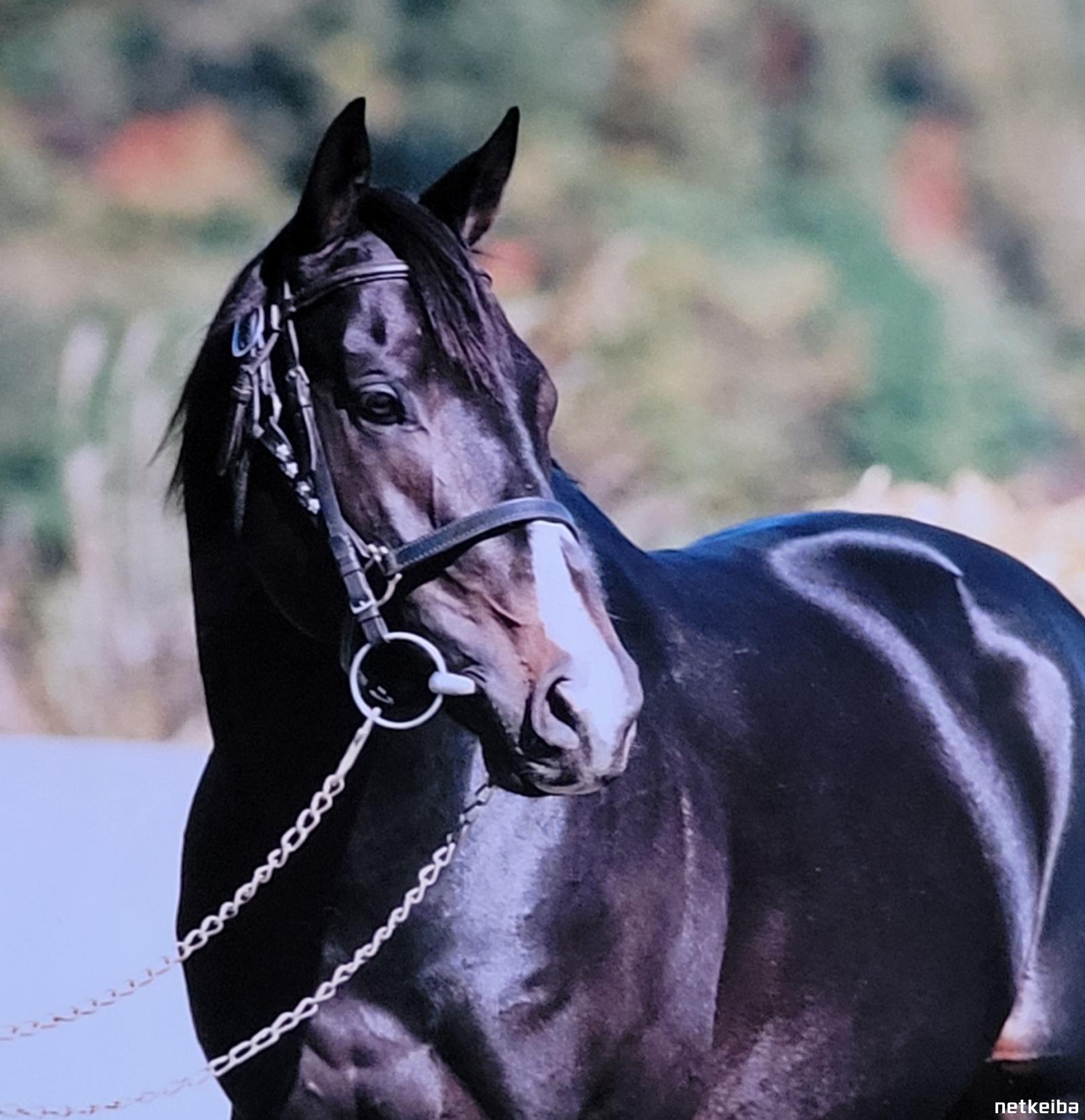
Narita Brian (ナリタブライアン) was a dark bay Japanese stallion whose commanding 1994 campaign made him a Japanese Triple Crown winner. Successful from 1,600 to 3,000 metres, he combined the Satsuki Sho, Tokyo Yushun and Kikuka Sho with victory in the Arima Kinen, establishing the three-year-old season that defines his place in 1990s Japanese racing.
Career at a glance
Featured races
Finished 1st · G1 · at Nakayama · over 1600m · Nakayama (JP)
Finished 1st · G1 · at Tokyo · over 2400m · Tokyo (JP)
Finished 1st · G1 · at Nakayama · over 2500m · Nakayama (JP)
At a glance
Foaled on 3 May 1991, Narita Brian was bred in Japan by Hayata Farms. He was by Brian’s Time, a son of Roberto, and out of Pacificus, whose sire was the enormously influential Northern Dancer. That mating joined Roberto’s paternal line with one of the most important international bloodlines on the dam’s side.
Pacificus also produced a notably accomplished family. Narita Brian’s older half-brother Biwa Hayahide won the 1994 Tenno Sho (Spring), while other siblings included Biwa Takehide, winner of the 1998 Radio Tampa Sho, and Biwa Venus, winner of the 1997 Okurayama Tokubetsu. Narita Brian nevertheless reached the family’s highest distinction through his sweep of Japan’s three colts’ classics.
He raced for owner Hidenori Yamaji and was trained by Masaaki Okubo at the Japan Racing Association’s Ritto training centre. Yamaji campaigned him under the “Narita” naming prefix.
Narita Brian competed from 1993 through 1996, making 21 starts for 12 wins, three second-place finishes and one third. Although his reputation rests chiefly on middle- and long-distance turf racing, his major victories ranged from the 1,600-metre Asahi Hai Sansai Stakes to the 3,000-metre Kikuka Sho.
The Asahi Hai Sansai Stakes provided the major success of Narita Brian’s two-year-old season. A leading juvenile event over 1,600 metres, it showed that he already possessed the speed to win at a mile before his later career established his effectiveness over substantially longer distances.
That juvenile victory was the foundation for his classic campaign. In early 1994 he continued his progression by winning the Kyodo Tsushin Hai and the Spring Stakes, two successes that preceded his attempt on Japan’s three-race Triple Crown.
The Satsuki Sho, the first leg of the Japanese Triple Crown, marked Narita Brian’s arrival as the central three-year-old of his crop. Racing over 2,000 metres, he won by three and a half lengths.
The performance mattered for more than its margin. Narita Brian had already demonstrated mile speed as a juvenile, but the Satsuki Sho confirmed that his ability carried into classic middle-distance competition. It also began a sequence in which his winning margin increased with each Triple Crown race.
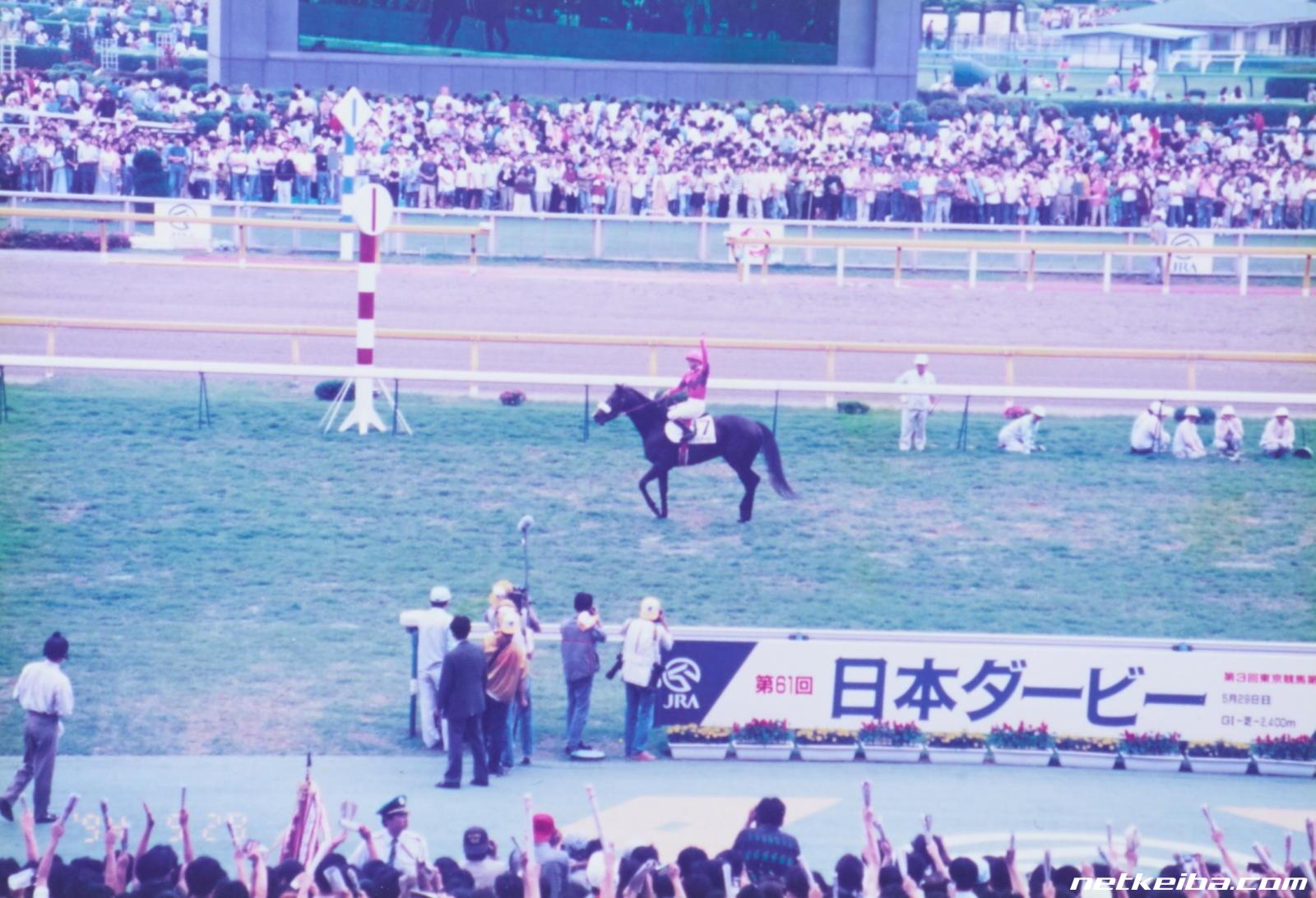
Narita Brian followed the Satsuki Sho with victory in the 1994 Tokyo Yushun, the Japanese Derby. He won the 2,400-metre classic by five lengths, extending his superiority as the distances increased.
The Derby is the central race in the Japanese three-year-old programme, and its place among Narita Brian’s achievements is reflected in his enduring identification as a Japanese Derby winner. The result gave him the first two Triple Crown legs and left the 3,000-metre Kikuka Sho as the final test of his range.
The Kikuka Sho completed the Triple Crown and produced Narita Brian’s most emphatic classic margin. He won by seven lengths over 3,000 metres, adding stamina at a long distance to the speed and tactical effectiveness he had shown earlier in his career.
Across the three classics, his margins rose from three and a half lengths in the Satsuki Sho to five in the Derby and seven in the Kikuka Sho. That progression gave the campaign an unusually decisive shape: the farther the classic series went, the more clearly he separated himself from his contemporaries.
By winning all three races, Narita Brian became the 1994 Japanese Triple Crown champion. The achievement remains the central fact of his racing legacy.
Narita Brian’s three-year-old season did not end with the Triple Crown. He also won the 1994 Arima Kinen, adding one of Japan’s foremost year-end races to his classic sweep.
That victory broadened the significance of his campaign. The classics had established his supremacy within his own generation; the Arima Kinen gave the season another major championship-level success beyond the formal Triple Crown series. Together, the four wins made 1994 the unmistakable high point of his career.
Narita Brian remained a major long-distance performer after his Triple Crown year. In 1995 he won the Hanshin Daishoten, a significant staying event, demonstrating that his Kikuka Sho success had not been an isolated display of stamina.
He returned to win the same race again in 1996. The second victory was especially memorable because it brought him into an extended duel with Mayano Top Gun. Narita Brian prevailed by a head, a very different kind of success from the wide-margin classic victories of 1994.
That contrast helps explain the race’s place in his career. The Triple Crown had been built on clear separation from his rivals, but the 1996 Hanshin Daishoten demanded a prolonged contest against another leading horse. The narrow verdict showed that Narita Brian could win not only by overwhelming a field with a sustained advance, but also by holding his advantage through a close finish.
The 1996 Hanshin Daishoten was the last major victory listed in his record. His racing career concluded that year, four seasons after it began.
Narita Brian generally raced as a stalker, settling close behind the leaders before producing a powerful, sustained move. That approach suited a horse whose best performances stretched across a broad range of turf distances: he could remain within striking distance without being committed to the lead, then use his finishing strength as the race developed.
His results illustrate unusual versatility. He won the 1,600-metre Asahi Hai Sansai Stakes as a juvenile, dominated the 2,000-metre Satsuki Sho and 2,400-metre Tokyo Yushun, and then extended successfully to 3,000 metres in the Kikuka Sho. He later reinforced his staying credentials with consecutive Hanshin Daishoten victories.
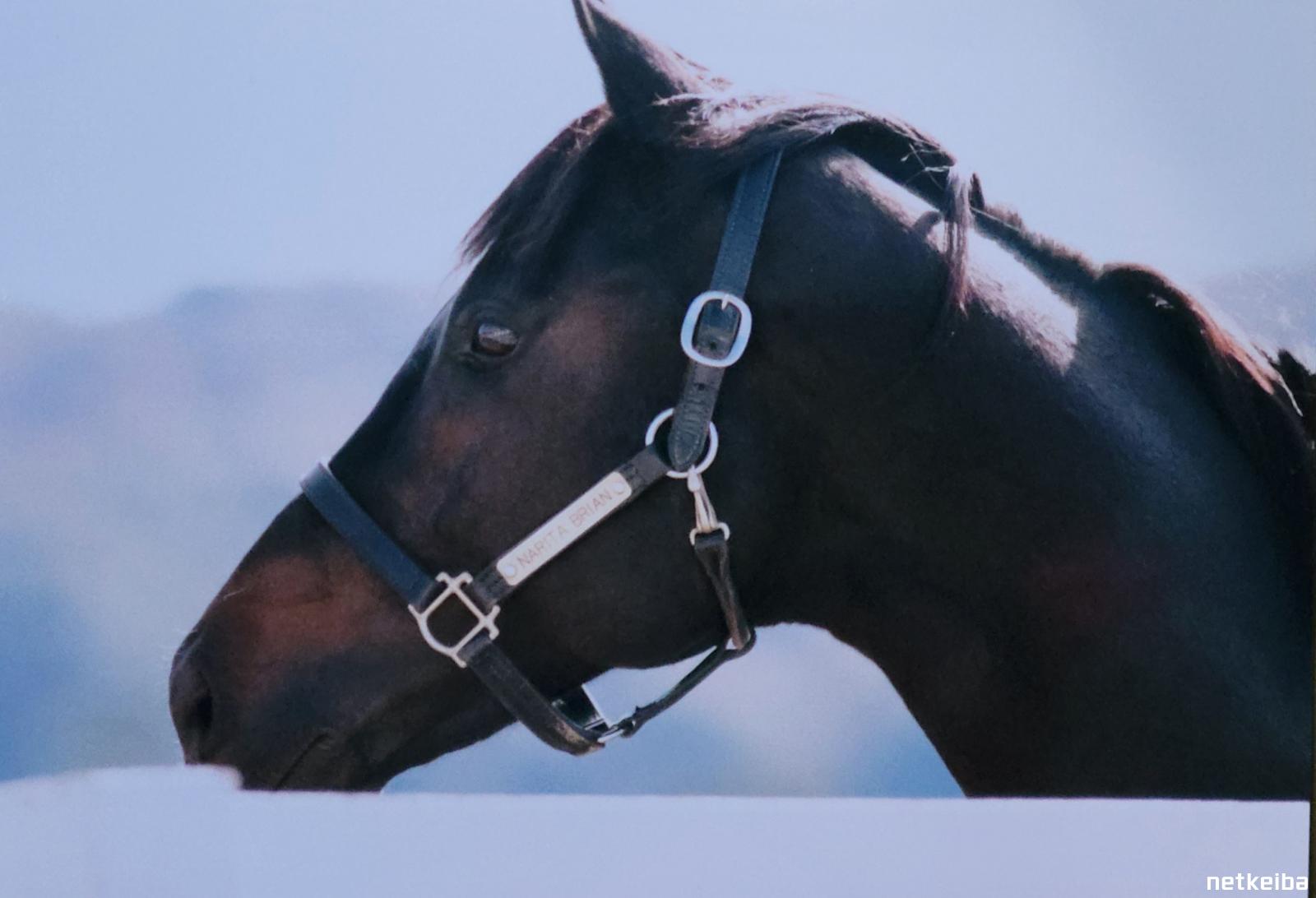
A shadow roll was among his recognizable racing attributes. Combined with his dark bay coat and forceful finishing run, it formed part of the visual identity associated with his performances. Yet his record was built on more than appearance or one spectacular season: he won major races as a juvenile, through the full range of the classic programme, and again as an older horse.
Narita Brian remained under the ownership of Hidenori Yamaji and the training of Masaaki Okubo. His official career totals—12 wins from 21 starts, with three seconds and one third—show that he finished in the first three in 16 of his 21 races.
His recorded career earnings totalled ¥1,026,916,000. Netkeiba separately lists ¥947.42 million in JRA earnings and no NAR earnings, reflecting a career conducted in JRA competition.
The major-win sequence captures the breadth of his accomplishments:
Narita Brian retired after his 1996 campaign. His legacy rests above all on the completeness of his 1994 season: three increasingly dominant classic victories, followed by success in the Arima Kinen. His ability to win major races from a mile through 3,000 metres also makes his record broader than that of a specialist confined to one distance category.
He died on 27 September 1998, aged seven. His life was brief, but his competitive record secured him a lasting place in Japanese racing history. The phrase “1994 Japanese Triple Crown winner” summarizes the formal achievement; the winning margins in the three classics—three and a half, five and seven lengths—convey the authority with which he accomplished it.
| Date | Race | Grade | Course | Going | Dist | Pos | Draw | Jockey | Wgt | SP | Time |
|---|---|---|---|---|---|---|---|---|---|---|---|
| 1996-05-19 |
TAKAMATSUNOMIYA HAI
|
G1 | Chukyo (JP) | Good | 1200 m | 4 | 5 | Yutaka Take | 57.0 kg | 4.3 | 1:08.2 |
| 1996-04-21 |
TENNO SHO (SPRING)
|
G1 | Kyoto (JP) | Good | 3200 m | 2 | 4 | K.Minai | 58.0 kg | 1.7 | 3:18.2 |
| 1996-03-09 |
HANSHIN DAISHOTEN
|
G2 | Hanshin (JP) | Good | 3000 m | 1 | 2 | Yutaka Take | 59.0 kg | 2.1 | 3:04.9 |
| 1995-12-24 |
ARIMA KINEN (40TH THE GRAND PRIX)
|
G1 | Nakayama (JP) | Good | 2500 m | 4 | 8 | Yutaka Take | 57.0 kg | 3.8 | 2:34.1 |
| 1995-11-26 | G1 | Tokyo (JP) | Good | 2400 m | 6 | 3 | Yutaka Take | 57.0 kg | 3.7 | 2:25.3 | |
| 1995-10-29 |
TENNO SHO (AUTUMN)
|
G1 | Tokyo (JP) | Good | 2000 m | 12 | 7 | H.Matoba | 58.0 kg | 2.4 | 1:59.4 |
| 1995-03-12 |
HANSHIN DAISHOTEN
|
G2 | Kyoto (JP) | Good | 3000 m | 1 | 1 | K.Minai | 58.0 kg | 1.0 | 3:08.2 |
| 1994-12-25 |
ARIMA KINEN (40TH THE GRAND PRIX)
|
G1 | Nakayama (JP) | Good | 2500 m | 1 | 11 | K.Minai | 55.0 kg | 1.2 | 2:32.2 |
| 1994-11-06 |
KIKUKA SHO (JAPANESE ST.LEGER)
|
G1 | Kyoto (JP) | Good to Soft | 3000 m | 1 | 4 | K.Minai | 57.0 kg | 1.7 | 3:04.6 |
| 1994-10-16 |
KYOTO SHIMBUN HAI
|
G2 | Hanshin (JP) | Good | 2200 m | 2 | 6 | K.Minai | 57.0 kg | 1.0 | 2:12.2 |
| 1994-05-29 |
TOKYO YUSHUN (JAPANESE DERBY)
|
G1 | Tokyo (JP) | Good | 2400 m | 1 | 17 | K.Minai | 57.0 kg | 1.2 | 2:25.7 |
| 1994-04-17 |
SATSUKI SHO (JAPANESE 2000 GUINEAS)
|
G1 | Nakayama (JP) | Good | 2000 m | 1 | 1 | K.Minai | 57.0 kg | 1.6 | 1:59.0 |
| 1994-03-27 |
FUJI TV SHO SPRING STAKES
|
G2 | Nakayama (JP) | Good | 1800 m | 1 | 2 | K.Minai | 56.0 kg | 1.2 | 1:49.1 |
| 1994-02-14 |
KYODO NEWS SERVICE HAI YONSAI STAKES
|
G3 | Tokyo (JP) | Good | 1800 m | 1 | 2 | K.Minai | 57.0 kg | 1.2 | 1:47.5 |
| 1993-12-12 |
ASAHI HAI SANSAI STAKES
|
G1 | Nakayama (JP) | Good | 1600 m | 1 | 8 | K.Minai | 54.0 kg | 3.9 | 1:34.4 |
| 1993-11-21 |
KYOTO SANSAI STAKES OP
|
OP | Kyoto (JP) | Good | 1800 m | 1 | 6 | K.Minai | 55.0 kg | 2.0 | 1:47.8 |
| 1993-11-06 |
DAILY HAI SANSAI STAKES
|
G2 | Kyoto (JP) | Good | 1400 m | 3 | 6 | K.Minai | 54.0 kg | 4.2 | 1:22.7 |
| 1993-10-24 |
KIMMOKUSEI TOKUBETSU ALW (1 Win)
|
Pre-OP | Fukushima (JP) | Good | 1700 m | 1 | 3 | E.Shimizu | 53.0 kg | 1.7 | 1:43.1 |
| 1993-09-26 |
HAKODATE SANSAI STAKES
|
G3 | Hakodate (JP) | Soft | 1200 m | 6 | 5 | K.Minai | 53.0 kg | 3.8 | 1:14.9 |
| 1993-08-29 |
3yo DBT
|
Maiden | Hakodate (JP) | Soft | 1200 m | 1 | 6 | K.Minai | 53.0 kg | 2.0 | 1:12.8 |
| 1993-08-15 |
3yo DBT
|
Maiden | Hakodate (JP) | Soft | 1200 m | 2 | 8 | K.Minai | 53.0 kg | 2.9 | 1:13.7 |
Citations
Imported and enriched race results from supported racing sources.


