

Uma profile

Admire Vega


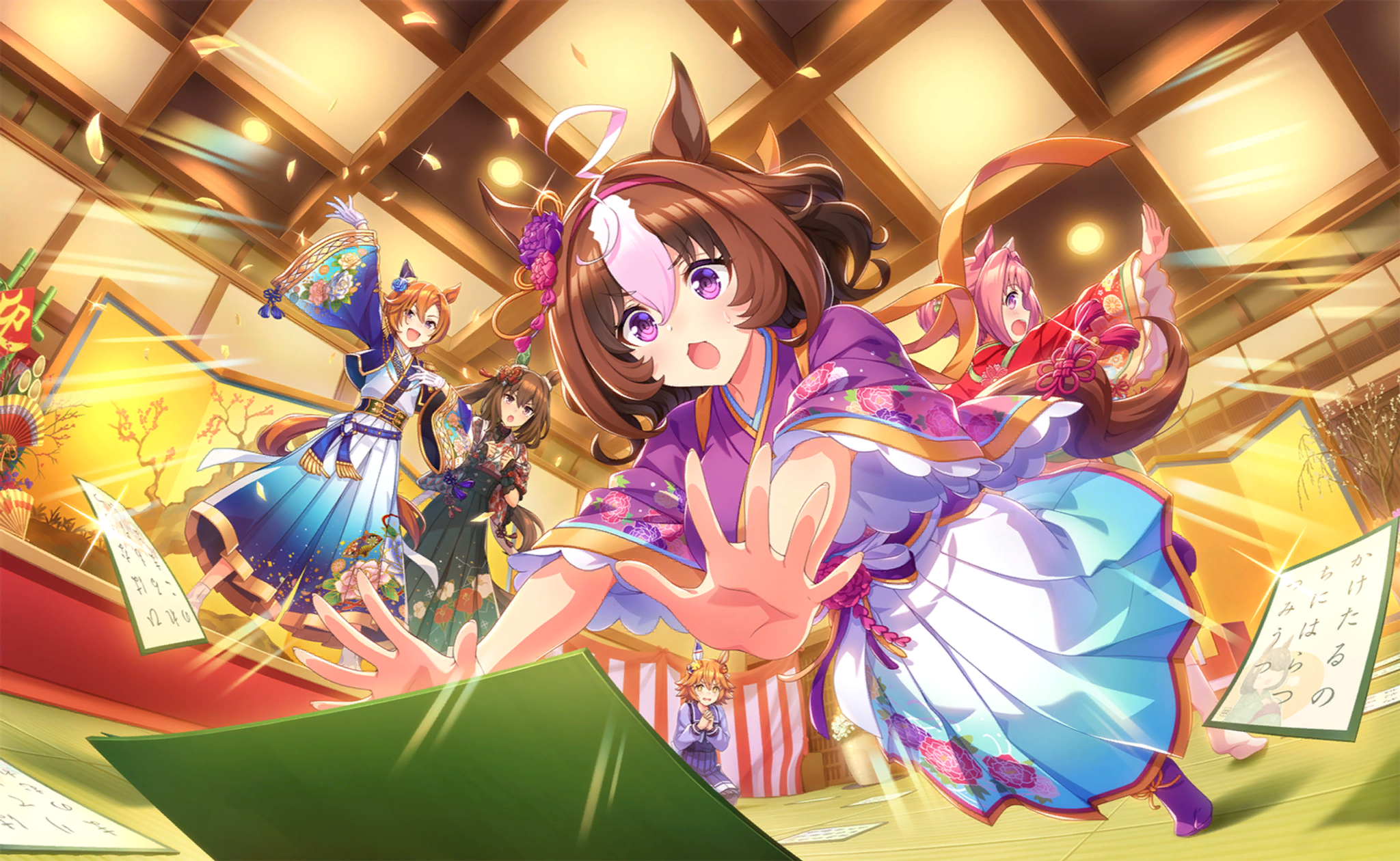
Admire Vega (Adomaiya Bega, アドマイヤベガ) carries herself with the kind of poised, composed presence that makes a simple nickname like Ayabe or Ayabe-san feel oddly fitting—short, neat, and a little elegant. A Senior Division student at Tracen Academy, she speaks with the straightforward self-pronoun Watashi and addresses her coach simply as Trainer, which suits her clean, no-nonsense air. She is voiced by Hitomi Sasaki, whose performance helps give her that memorable polish.
In the day-to-day details, Admire Vega is compact and refined: 157 cm tall, with a recorded weight note of “No change”, and listed measurements of B85-W57-H82. Even the archive stats feel tidy in her case, right down to her 23.0 cm shoes on both left and right. She was born on March 12 and lives in Ritto Dormitory, where her roommate is Curren Chan—a pairing that is hard not to notice, if only because it places her alongside one of the setting’s most distinct personalities.
Her relationship web places her firmly among some major names. Narita Top Road, T.M. Opera O, and Meisho Doto are all noted as rivals, giving her competitive context with no shortage of intensity. She is also listed in connection with Silence Suzuka, alongside Curren Chan, Top Road, Opera O, and Doto. Even without embellishment, that roster gives Admire Vega a strong dramatic silhouette: she stands in company where pressure, talent, and reputation are all very real.
Admire Vega’s archived profile data is light on personal likes, dislikes, and private quirks, so what comes through most clearly is her presentation: polished, serious, and quietly striking. Sometimes that kind of restraint can be its own charm. She does not need a wall of trivia to leave an impression; the name, the rivals, and that composed bearing already do plenty of work.
Sources










Touch fallback
Admire VegaTouch and smaller layouts use grouped connection cards instead of the live radar. Open any entry to follow the relationship directly.
Same races
Same Races
2 shared rivals
Related Umas
5 total · 5 linked


Rivals
3 total · 3 linked
Stablemates
1 total · 1 linked
Mentioned By Related Umas
1 profile
Mentioned By Rivals
1 profile
Mentioned By Stablemates
1 profile
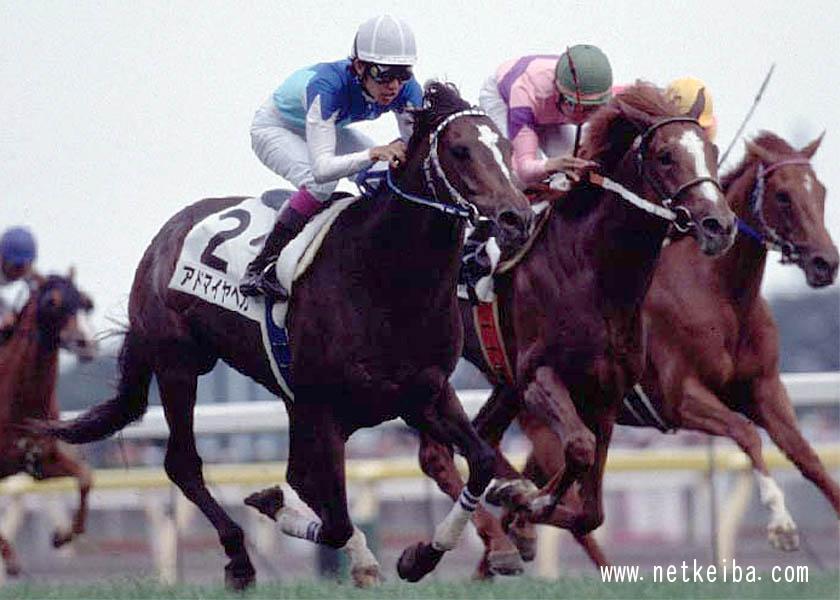
Admire Vega was a Japanese Thoroughbred whose short career was crowned by victory in the 1999 Tokyo Yūshun (Japanese Derby). A Northern Farm-bred son of Sunday Silence and the Classic-winning mare Vega, he raced only eight times but became a central figure in a memorable three-way rivalry with Narita Top Road and T.M. Opera O.
Career at a glance
Track record
Featured races
Finished 1st · G1 · at Tokyo · over 2400m · Tokyo (JP)
Finished 1st · G3 · at Hanshin · over 2000m · Hanshin (JP)
Finished 1st · G2 · at Kyoto · over 2200m · Kyoto (JP)
At a glance
Origins and pedigree
A bay stallion foaled on 12 March 1996, Admire Vega was bred by Northern Farm and raced for owner Riichi Kondo. He was trained at Ritto by Mitsuru Hashida, while Yutaka Take rode him in every race of his career.
His pedigree united two of the most important influences in Japanese breeding. His sire, Sunday Silence, had won the Kentucky Derby, Preakness Stakes and Breeders’ Cup Classic in the United States before becoming a transformative stallion in Japan. Admire Vega was therefore a direct representative of the Sunday Silence sire line that came to dominate Japanese racing.
His dam, Vega, was an outstanding racemare in her own right. A daughter of Prix de l’Arc de Triomphe winner Tony Bin, she won both the Oka Sho and Yūshun Himba in 1993. Admire Vega was her first foal, extending her Classic legacy from the racecourse into the breeding shed. She later produced Admire Don, Admire Boss and Captain Vega, making the family notable across several seasons and racing disciplines.
Vega’s pregnancy with Admire Vega began as a twin conception. Because twin pregnancies carry severe risks in Thoroughbreds, one embryo was reduced and the other developed into Admire Vega. He was thus the surviving foal of an early twin pregnancy rather than a foal born alongside a twin.
Career at a glance
- Record: 8 starts, 4 wins, 1 second
- Career earnings: ¥290,602,000
- Major victory: 1999 Tokyo Yūshun (Japanese Derby), G1
- Other graded wins: 1998 Radio Tampa Hai Sansai Stakes, G3; 1999 Kyoto Shimbun Hai, G2
- Owner: Riichi Kondo
- Trainer: Mitsuru Hashida
- Jockey throughout his career: Yutaka Take
- Principal rivals: Narita Top Road and T.M. Opera O
Racing career
A rapid rise at two
Admire Vega debuted at Kyoto on 7 November 1998 in a 1,600-metre turf race. His official result was fourth in a field of 14, with Mayano Matador recorded as the winner. Whatever the disappointment of that opening result, he quickly established himself over longer distances.
On 5 December he moved up to 2,000 metres for the Erica Sho at Hanshin. Racing on good-to-soft turf, he defeated Thrilling Sunday to secure his first official victory. Three weeks later he returned over the same course and distance for the Radio Tampa Hai Sansai Stakes.
That Grade 3 contest was the decisive step in his juvenile campaign. Admire Vega beat Matikane Kinnohosi in an 11-runner field, giving him a first graded success and completing his two-year-old season with two wins from three starts. Both victories had come over 2,000 metres, pointing him firmly toward the following year’s middle-distance Classics.
Classic trials and a Satsuki Sho setback
Admire Vega began 1999 in the Grade 2 Yayoi Sho at Nakayama on 7 March. Run over 2,000 metres, the race brought him into direct competition with Narita Top Road, who defeated him into second place. That result established one of the defining rivalries of the season.
The first Classic, the Satsuki Sho, followed at Nakayama on 18 April. Admire Vega finished sixth in the 17-runner field. Victory went to T.M. Opera O, with Narita Top Road also among the leading finishers.
The result reshaped the Classic picture. Narita Top Road had beaten Admire Vega in the principal trial, while T.M. Opera O had claimed the first Triple Crown leg. Admire Vega entered the Japanese Derby without a victory that season, but his juvenile record and Yayoi Sho second still placed him among the leading members of his generation.
Defining races
1999 Tokyo Yūshun: the Derby breakthrough
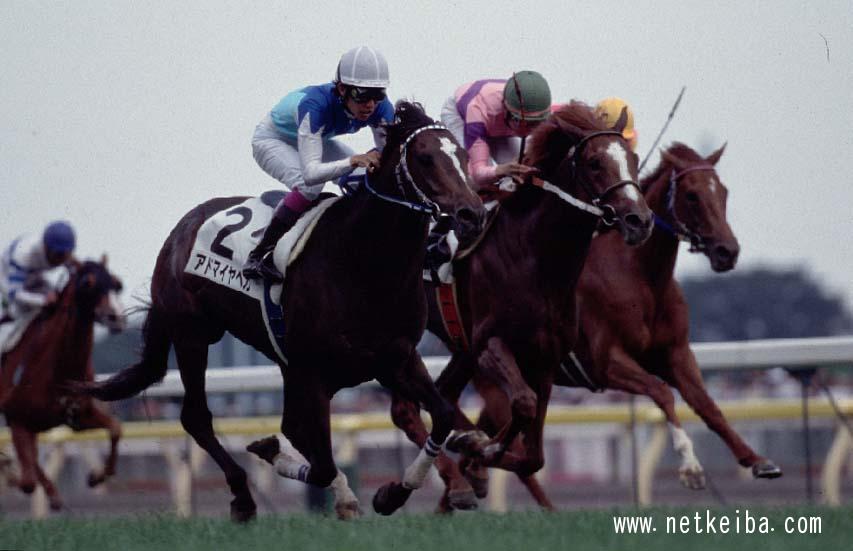
The defining performance of Admire Vega’s career came at Tokyo Racecourse on 6 June 1999. The Tokyo Yūshun, run over 2,400 metres on good turf, assembled an 18-horse field headed by the principal Classic colts.
Admire Vega was held toward the rear by Yutaka Take, leaving him with substantial ground to recover as the field turned for home. Narita Top Road held a more prominent position and carried a tactical advantage into the straight, while T.M. Opera O was also involved in the finish.
Once asked for his effort, Admire Vega produced the acceleration that became the signature of his racing career. He advanced through the field and caught Narita Top Road near the finish, winning by a neck. T.M. Opera O took third, placing the three horses who would define the 1999 Classic season together at the head of Japan’s most important race for three-year-olds.
The victory carried significance beyond the immediate result. Vega had won the Yūshun Himba, or Japanese Oaks, at Tokyo in 1993; six years later, her first foal won the Japanese Derby over the same course. Take had also ridden Special Week to victory in the 1998 Derby, and his success aboard Admire Vega made him the first jockey to win the race in consecutive years.
For Admire Vega, the Derby transformed a promising record into a lasting reputation. It was his only Grade 1 victory, but it came at the centre of the Japanese racing calendar and against the two colts with whom his generation would be most closely associated.
Kyoto Shimbun Hai: confirmation in the autumn
After a summer break, Admire Vega returned in the Kyoto Shimbun Hai on 17 October. The Grade 2 race was then contested over 2,200 metres and served as a preparation for the 3,000-metre Kikuka Sho.
Facing Narita Top Road again, Admire Vega defeated him in an 18-runner field. The result was important because it confirmed that the Derby had not been an isolated peak: four months later, Admire Vega remained capable of beating a leading rival over a middle-distance trip.
The Kyoto Shimbun Hai became his fourth and final victory. Three of those four wins had come in graded company, a concentrated record of quality from a horse whose entire racing life lasted less than a year.
Kikuka Sho: the Classic division completed
Admire Vega’s final appearance came in the Kikuka Sho at Kyoto on 7 November 1999. The last leg of the Japanese Triple Crown stretched to 3,000 metres, considerably farther than the distances over which he had won.
He finished sixth in the 15-horse field. Narita Top Road won, while T.M. Opera O was among the principal contenders. The result completed an unusually balanced division of the three Classics:
Triple Crown race Winner Satsuki Sho T.M. Opera O Tokyo Yūshun Admire Vega Kikuka Sho Narita Top RoadEach of the three leading colts had therefore taken one leg. That division gave the 1999 season a clear structure and made their rivalry central to Admire Vega’s historical identity.
Connections and racing style
The continuity of Admire Vega’s connections was notable throughout his compact career. Riichi Kondo owned him, Mitsuru Hashida trained him, and Yutaka Take rode him in all eight starts, from his Kyoto debut through the Kikuka Sho exactly one year later.
His record marked him primarily as a middle-distance horse. All four victories came between 2,000 and 2,400 metres: the Erica Sho and Radio Tampa Hai Sansai Stakes over 2,000 metres, the Kyoto Shimbun Hai over 2,200 metres, and the Derby over 2,400 metres.
His best-known weapon was late acceleration. The Derby provided the clearest example, with Admire Vega settling behind much of the field before delivering one sustained finishing run. That approach could leave him dependent on position and racing room, but at Tokyo it produced the performance on which his reputation rests.
The Kikuka Sho result also drew a natural boundary around his strongest range. His greatest achievements came at middle distances rather than the 3,000 metres of the final Classic.
Retirement and stud career
Admire Vega remained in training after his three-year-old campaign, but suspensory-ligament inflammation ended his racing career before he could compete as an older horse. He retired in 2000 with a record of four wins and one second from eight starts.
His absence was especially consequential because Narita Top Road and T.M. Opera O continued racing. T.M. Opera O developed into the dominant older horse of 2000, but Admire Vega never had the opportunity to renew their rivalry beyond their three-year-old season.
Admire Vega entered stud at Shadai Stallion Station. His appeal as a stallion rested on an exceptional combination: he was a Japanese Derby winner, a direct son of Sunday Silence, and the first foal of a mare who had won two Japanese Classics.
Although his stud career was brief, his offspring included graded performers such as T.M. Dragon, Monroe Blond and Black Altair. T.M. Dragon became particularly notable as a leading steeplechaser, showing that Admire Vega’s influence was not confined to the middle-distance turf races in which he had made his own name.
Death and legacy
Admire Vega died on 29 October 2004 at only eight years of age. His death was attributed to an acute stomach rupture. A memorial service was held at Shadai Stallion Station on 23 November.
His place in Japanese racing history rests on achievements compressed into an unusually short span. He was a graded winner at two, a Derby winner at three and one of the three colts who divided the 1999 Triple Crown among themselves. His eight-start record did not permit a long championship campaign, yet the quality of his best races—above all his late Derby victory over Narita Top Road, with T.M. Opera O third—ensured that he remained closely identified with his generation.
Pedigree also deepened that legacy. As the son of Sunday Silence and Vega, he joined a dominant sire line to a distinguished Classic-winning female family. Injury curtailed his racing career, and his death shortened his time at stud, but the Derby supplied an enduring centrepiece: Vega’s first foal returning to Tokyo to win the colts’ Classic six years after his dam had won the Oaks there.
Sources
- netkeiba — horse profile, pedigree and career summary
- JBIS-Search — profile, pedigree and tabulated race record
- netkeiba — 1998 Radio Tampa Hai Sansai Stakes result
- netkeiba — 1999 Yayoi Sho result
- netkeiba — 1999 Satsuki Sho result
- netkeiba — 1999 Tokyo Yūshun result
- netkeiba — 1999 Kyoto Shimbun Hai result
- netkeiba — 1999 Kikuka Sho result
- Wikipedia — career, stud and death summary
- https://en.netkeiba.com/db/race/199808060103/
- https://en.netkeiba.com/db/race/199809060110/
| Date | Race | Grade | Course | Going | Dist | Pos | Draw | Jockey | Wgt | SP | Time |
|---|---|---|---|---|---|---|---|---|---|---|---|
| 1999-11-07 |
KIKUKA SHO (JAPANESE ST.LEGER)
|
G1 | Kyoto (JP) | Good | 3000 m | 6 | 14 | Yutaka Take | 57.0 kg | 2.3 | 3:08.2 |
| 1999-10-17 |
KYOTO SHIMBUN HAI
|
G2 | Kyoto (JP) | Good | 2200 m | 1 | 11 | Yutaka Take | 57.0 kg | 3.0 | 2:12.3 |
| 1999-06-06 |
TOKYO YUSHUN (JAPANESE DERBY)
|
G1 | Tokyo (JP) | Good | 2400 m | 1 | 2 | Yutaka Take | 57.0 kg | 3.9 | 2:25.3 |
| 1999-04-18 |
SATSUKI SHO (JAPANESE 2000 GUINEAS)
|
G1 | Nakayama (JP) | Good | 2000 m | 6 | 2 | Yutaka Take | 57.0 kg | 2.7 | 2:01.3 |
| 1999-03-07 |
HOCHI HAI YAYOI SHO
|
G2 | Nakayama (JP) | Good to Soft | 2000 m | 2 | 6 | Yutaka Take | 55.0 kg | 1.5 | 2:03.7 |
| 1998-12-26 |
RADIO TAMPA HAI SANSAI STAKES
|
G3 | Hanshin (JP) | Good | 2000 m | 1 | 4 | Yutaka Take | 54.0 kg | 2.1 | 2:04.1 |
| 1998-12-05 |
ERICA SHO ALW (1 Win)
|
Pre-OP | Hanshin (JP) | Good to Soft | 2000 m | 1 | 6 | Yutaka Take | 54.0 kg | 1.2 | 2:06.1 |
| 1998-11-07 |
3yo DBT
|
Maiden | Kyoto (JP) | Good | 1600 m | 4 | 1 | Yutaka Take | 54.0 kg | 1.7 | 1:35.1 |
Citations
Race Result Sources
AI Race Import 2026-07-14 12:32 UTC
Imported and enriched race results from supported racing sources.