


No gallery yet
No shared-tag appearances yet.
No other media entries currently tag this Uma into their supporting images.

Uma profile

No gallery yet
No other media entries currently tag this Uma into their supporting images.
Touch fallback
Red RumTouch and smaller layouts use grouped connection cards instead of the live radar. Open any entry to follow the relationship directly.
4 total · 4 linked
4 total · 4 linked
1 profile
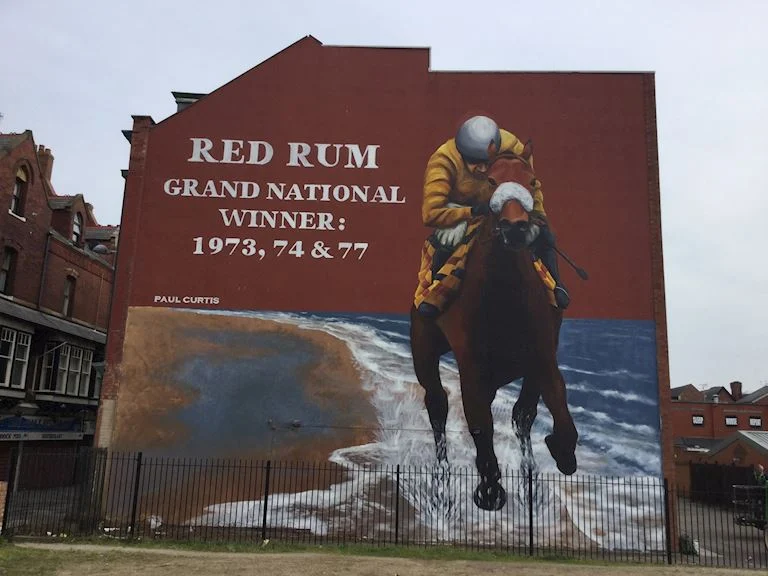
Red Rum (3 May 1965–18 October 1995) was an Irish-bred bay gelding whose record in the Grand National made him one of the defining steeplechasers of the 1970s. He won the Aintree race three times—in 1973, 1974 and 1977—and finished second in 1975 and 1976, completing five consecutive editions in either first or second place.
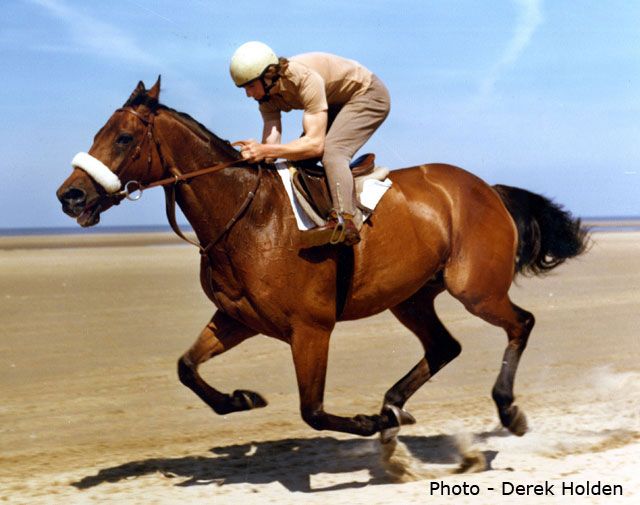
Career at a glance
Featured races
Finished 1st · G1 · at Aintree · over 6907m · Aintree (UK)
Finished 1st · G1 · at Aintree · over 6907m · Aintree (UK)
Finished 1st · G1 · at Aintree · over 6907m · Aintree (JP)
At a glance
Foaled in Ireland on 3 May 1965, Red Rum was by Quorum, a son of Vilmorin, and out of Mared. He was a gelding and developed into a long-distance steeplechaser whose career became closely associated with Aintree and the exceptional demands of the Grand National.
Red Rum raced for Noel le Mare and was trained by Ginger McCain. Under McCain’s care in Southport, he emerged as a specialist in staying chases: a durable competitor with the stamina to remain effective over the Grand National’s extended distance and the ability to finish his races strongly.
Red Rum began his career on the Flat before finding his defining role over fences. His overall record was 100 starts, 24 wins, 15 seconds and 23 thirds, with earnings of £146,409.80. Those figures reflect sustained competitiveness, but his reputation rests above all on an extraordinary sequence at Aintree between 1973 and 1977.
Brian Fletcher rode him in the first four races of that sequence, including the victories of 1973 and 1974 and the runner-up finishes of 1975 and 1976. Tommy Stack partnered him when he returned to win for a third time in 1977.
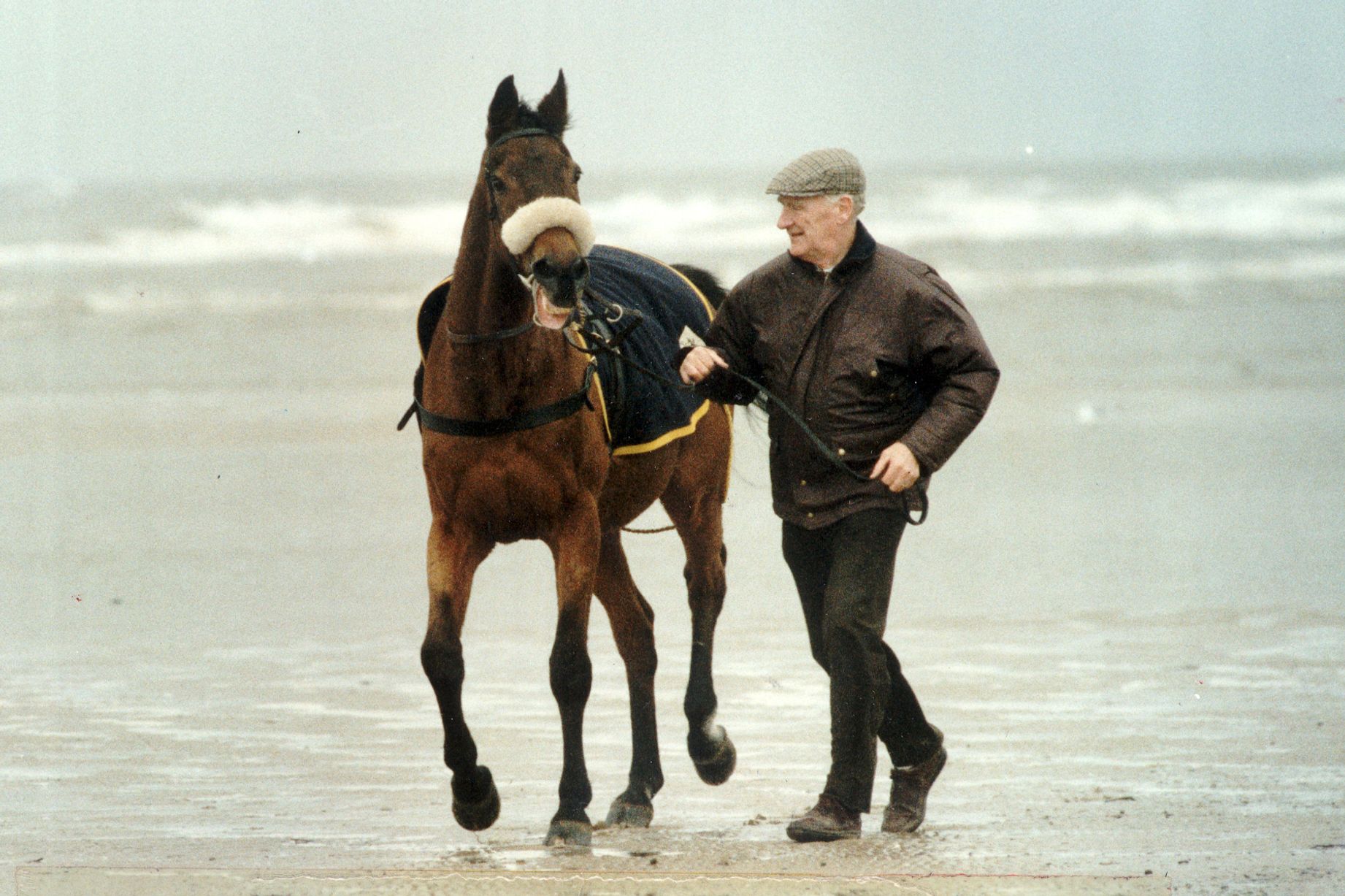
Red Rum’s first Grand National success came at Aintree on 31 March 1973. Ridden by Brian Fletcher over approximately 6,907 metres on good ground, he faced Crisp, the Australian chaser who established a commanding advantage while carrying a substantial weight.
The contest became a test of pursuit and stamina. Red Rum, racing as the closer, gradually reduced Crisp’s lead and caught him near the finish, winning by three-quarters of a length. The performance supplied the first proof of his unusual suitability for the Grand National: he could negotiate its long course and still produce a decisive finish after the race had placed sustained demands on his stamina.
That victory established Red Rum as an elite staying chaser, but it was only the beginning of a sequence that would define his career.
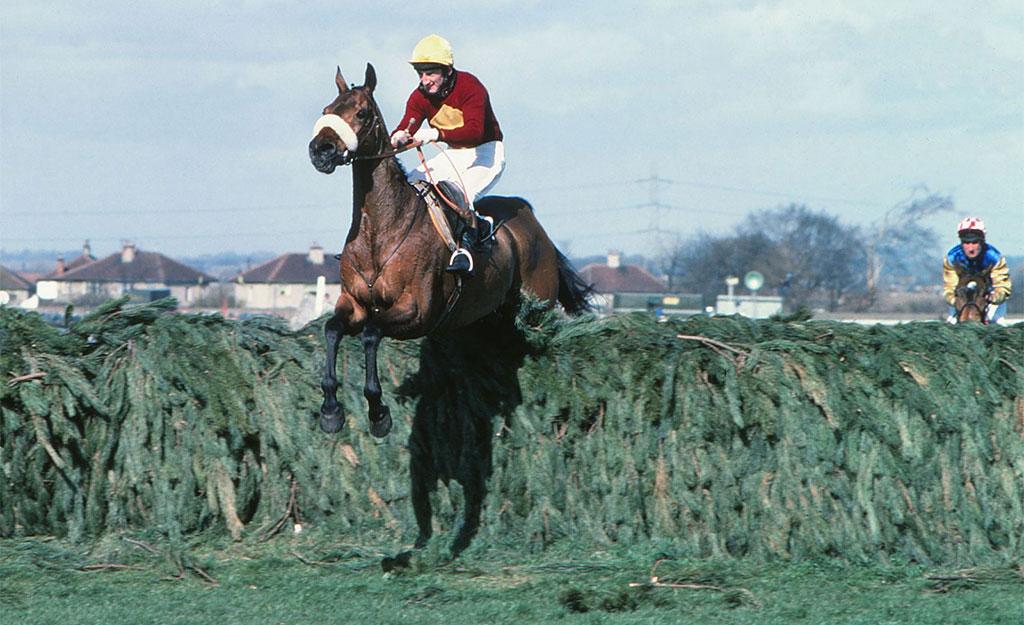
Red Rum returned to Aintree on 30 March 1974 and successfully defended his Grand National title. Again ridden by Fletcher, he won over the same extended distance, this time on soft going. Winning consecutive editions confirmed that the previous year’s result had not been an isolated performance; Red Rum had become the outstanding Grand National specialist of his era.
Three weeks later, on 20 April, he contested the Scottish Grand National at Ayr. The race covered approximately 6,547 metres and was run on firm ground, markedly different conditions from the soft surface he had encountered at Aintree. Red Rum nevertheless won again under Fletcher.
The two successes made him the only horse credited by the contemporary record with winning the Grand National and Scottish Grand National in the same season. The double was especially significant because it required him to win two demanding long-distance chases in quick succession and under contrasting conditions. It broadened his standing beyond Aintree while reinforcing the qualities on which his reputation was built: adaptability, durability and exceptional stamina.
A third consecutive Grand National victory eluded Red Rum in 1975, but he still finished second under Fletcher. Rather than ending his period at the top, that placing began another important part of his record: his ability to return year after year and remain competitive in the race most closely associated with him.
He was second again in 1976, this time ridden by Tommy Stack. By then, Red Rum had completed four consecutive Grand Nationals in the first two places—two victories followed by two runner-up finishes. Even without a win in either year, the sequence demonstrated a level of sustained performance that became central to his stature. The Grand National was not merely a race he had won twice; it was an event in which he remained a leading force across multiple seasons.
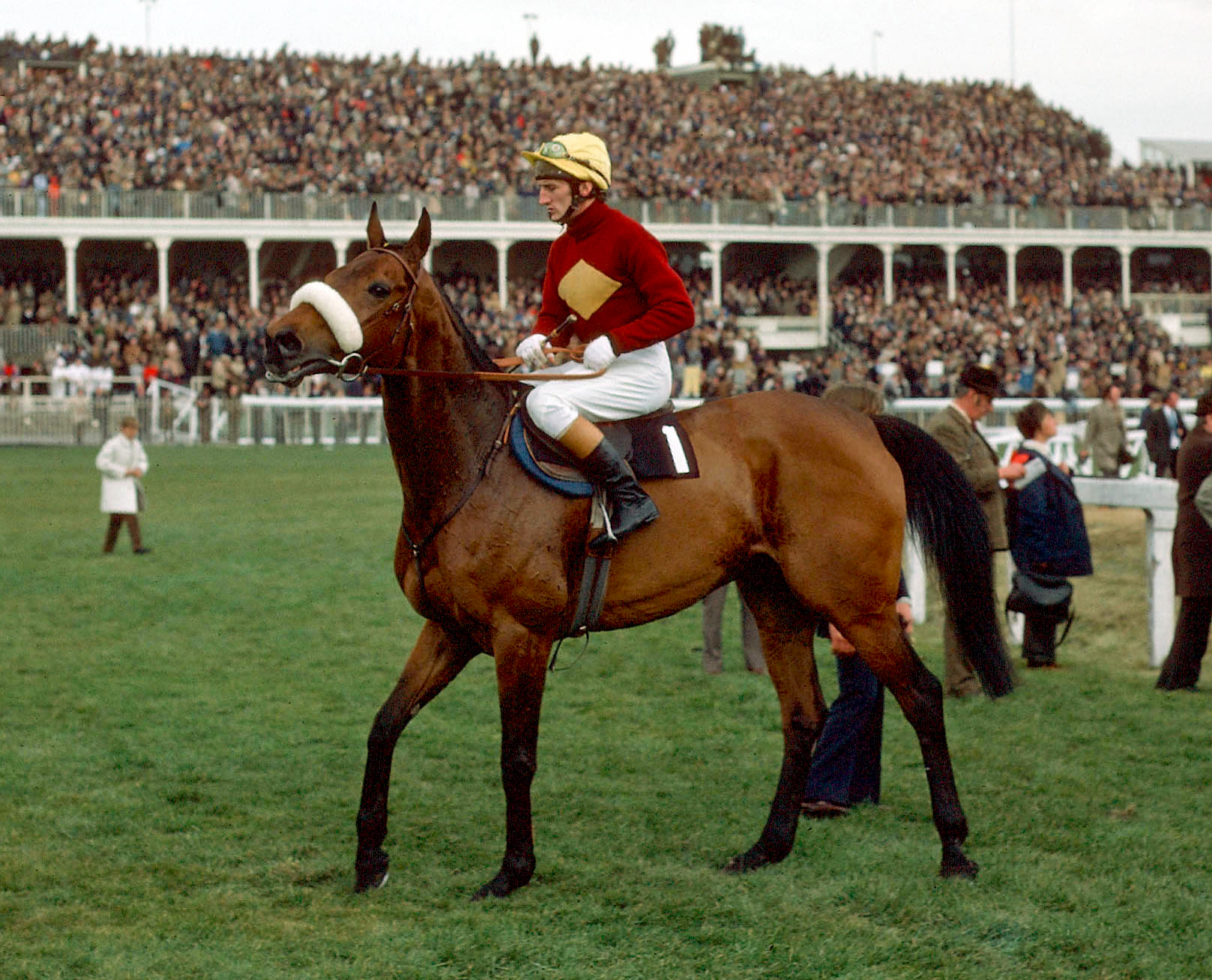
On 2 April 1977, Red Rum returned to Aintree at the age of 12. Stack again took the ride, and the race was staged on good going over approximately 6,907 metres.
Red Rum won, three years after his second National and following two successive runner-up finishes. The victory completed his unique three-win record and gave his five-year sequence its final shape: first in 1973, first in 1974, second in 1975, second in 1976 and first in 1977.
This third success was more than another major prize. It confirmed his longevity and completed a comeback from two years of near misses. His first National had showcased his finishing power; the second established his supremacy; the third, achieved as a 12-year-old, made endurance across seasons as important to his story as stamina within a single race.
Ginger McCain’s name became inseparable from Red Rum’s rise as a steeplechaser. Based in Southport, McCain trained him through the period in which he accumulated his five consecutive first-or-second finishes at Aintree and achieved the 1974 National double.
The jockey partnership changed during the sequence without interrupting Red Rum’s consistency. Brian Fletcher rode him to the 1973 and 1974 Grand National victories and to second place in 1975. Tommy Stack was aboard for the runner-up finish in 1976 and the historic third victory in 1977.
Red Rum’s racing profile was that of a staying chaser and closer. His defining 1973 success illustrated that pattern particularly clearly: he conserved enough strength through a long, exacting contest to overhaul Crisp late. Across his career, he combined finishing ability with the sustained stamina required by races extending beyond six and a half kilometres.
His record also reflects unusual consistency. He finished in the first three in 62 of his 100 starts: 24 wins, 15 seconds and 23 thirds. While the Grand National supplied his greatest stage, the Scottish Grand National victory showed that his long-distance ability could be carried successfully to another major course and different ground.
Red Rum retired in 1978 after a career that had made him a widely recognised public figure. He subsequently appeared at Aintree and at racing events around Britain, maintaining his connection with the racecourse where his reputation had been forged.
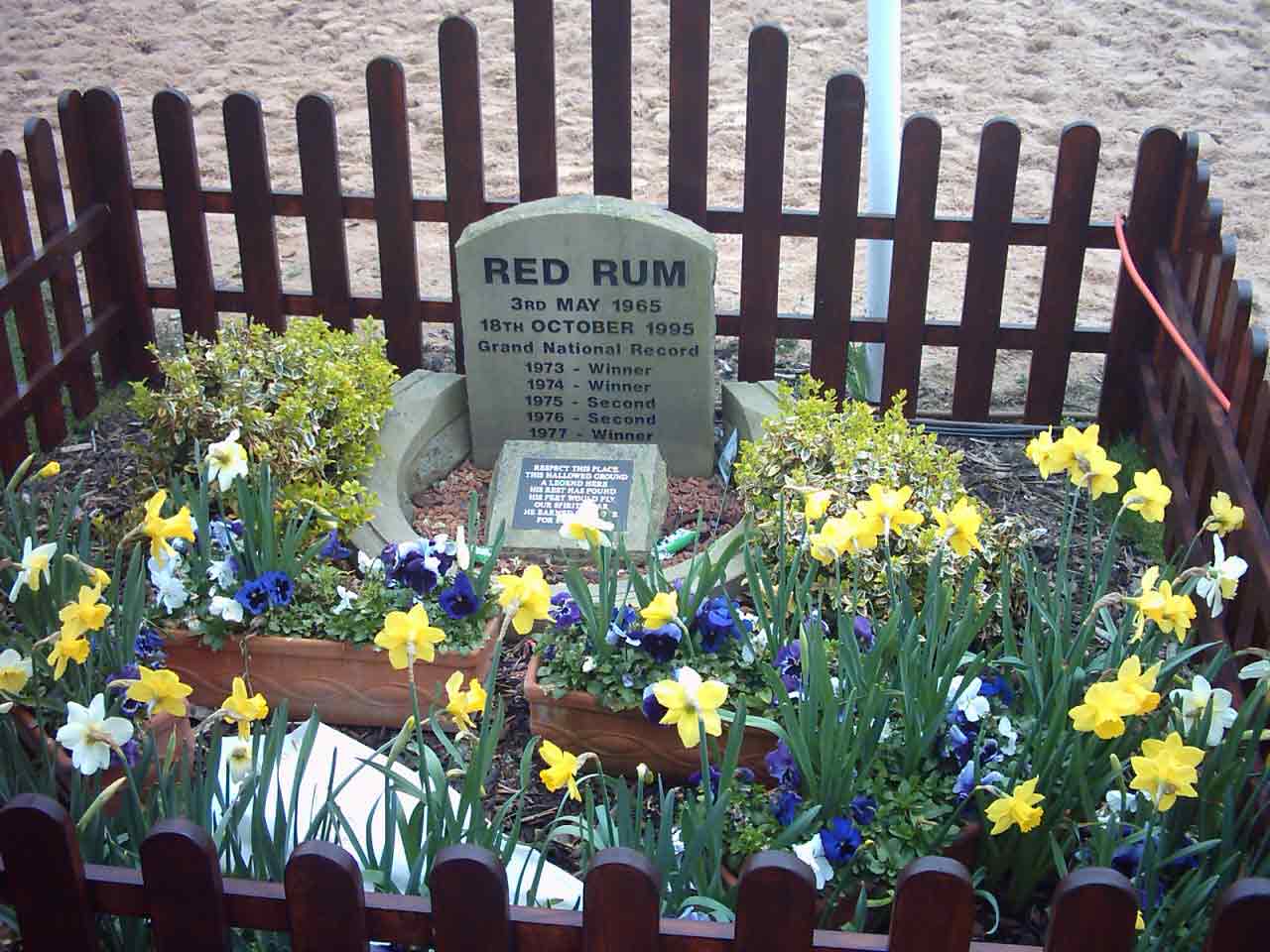
He died on 18 October 1995, aged 30, and was buried beside the winning post at Aintree. The location linked his memorial directly to the finish toward which he had driven in five successive Grand Nationals.
His commemoration extends beyond the burial site. A life-size statue stands at Aintree Racecourse, while another bronze statue is displayed in Wayfarers Arcade in Southport, the town associated with McCain’s training operation. Aintree also stages the Red Rum Handicap Chase in his name.
The enduring basis of that legacy is a concentrated but remarkable set of achievements. Red Rum was a three-time Grand National winner, a twice runner-up in the same race and the winner of the Grand National–Scottish Grand National double in 1974. His sequence from 1973 through 1977 transformed repeated participation into sustained mastery, making him not simply a multiple winner but the horse most closely identified with Aintree’s greatest race.
More photographs
2 more images
| Date | Race | Grade | Course | Going | Dist | Pos | Draw | Jockey | Wgt | SP | Time |
|---|---|---|---|---|---|---|---|---|---|---|---|
| 1977-04-02 |
Grand National
|
G1 | Aintree (JP) | Good | 6907 m | 1 | - | Tommy Stack | 73.5 kg | 11/1 | 9:30.3 |
| 1976-04-03 |
Grand National
|
G1 | Aintree (JP) | - | 6907 m | 2 | - | Tommy Stack | - | 10/1 | - |
| 1975-03-29 |
Grand National
|
G1 | Aintree (UK) | - | 6907 m | 2 | - | Brian Fletcher | - | 7/2 | - |
| 1974-04-20 |
Scottish Grand National
|
G3 | Ayr (UK) | Firm | 6547 m | 1 | - | Brian Fletcher | 75.8 kg | - | 8:08.6 |
| 1974-03-30 |
Grand National
|
G1 | Aintree (UK) | Soft | 6907 m | 1 | - | Brian Fletcher | 76.2 kg | 11/1 | - |
| 1973-03-31 |
Grand National
|
G1 | Aintree (UK) | Good | 6907 m | 1 | - | Brian Fletcher | 65.8 kg | 9/1 | 9:01.9 |


