
No gallery media has been attached to this placeholder yet.
No gallery yet
No tagged archive images found.
This draft does not have shared gallery appearances in the archive yet.

AI-generated draft

This profile was created using UmaArchive's AI-assisted research pipeline and will remain outside search indexing until an editor approves it.
This unapproved preview can include facts and copy from the latest saved research bundle. It is excluded from search indexing until an editor validates the persisted profile.
Montjeu (モンジュー) is a world-class French racer whose presence immediately raises the stakes from national glory to international supremacy. Memorable as a formidable foreign challenger, she defeated El Condor Pasa in the Prix de l’Arc de Triomphe before traveling to Japan to face Special Week in the Japan Cup.
She debuted in the game’s Main Story, Part 1 Final Chapter, serving as a non-playable rival with a truly imposing résumé. Montjeu’s role is built around elite competition: she is not merely visiting from abroad, but arriving as a proven champion capable of testing Japan’s finest on their own turf.
Her defining rivalries stretch across two of racing’s grandest stages. El Condor Pasa confronted her at the Prix de l’Arc de Triomphe, while Special Week met her challenge in the Japan Cup. Venus Paques is also closely associated with Montjeu, admiring her as a student and addressing her as her master—a relationship that further emphasizes the stature Montjeu commands.
Montjeu holds a notable place in the franchise as the first officially named foreign-trained racehorse represented as an Uma Musume. Before permission was obtained to use her name, the anime featured Broye as an unofficial Montjeu-inspired substitute. She refers to herself with the composed Watashi, and is voiced by Arisa Sakuraba.
No gallery media has been attached to this placeholder yet.
No gallery yet
This draft does not have shared gallery appearances in the archive yet.
Touch fallback
MontjeuTouch and smaller layouts use grouped connection cards instead of the live radar. Open any entry to follow the relationship directly.
Same races
4 shared rivals

Latest: King George VI and Queen Elizabeth Stakes · 2000-07-29

Latest: JAPAN CUP · 1999-11-28

Latest: JAPAN CUP · 1999-11-28

Latest: PRIX DE L'ARC DE TRIOMPHE LUCIEN BARRIERE · 1999-10-03
Montjeu was an Irish-bred bay Thoroughbred whose 11 victories from 16 starts included the 1999 Prix du Jockey Club, Irish Derby and Prix de l’Arc de Triomphe. Europe’s Cartier Three-Year-Old Colt of 1999, he remained in training at four and added three more major middle- and long-distance turf prizes, headed by the King George VI and Queen Elizabeth Stakes.
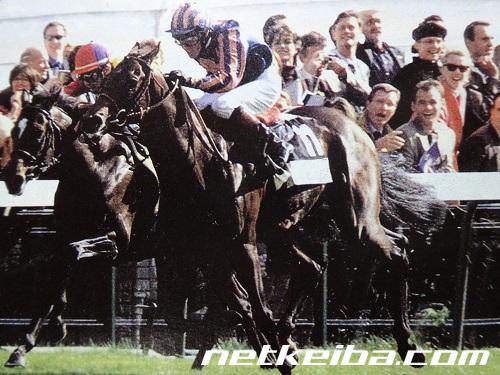
Career at a glance
Featured races
Finished 1st · G1 · at Chantilly · over 2400m · Chantilly (JP)
Finished 1st · G1 · at Longchamp · over 2400m · Longchamp (JP)
Finished 1st · G1 · at Uk · over 2400m · Uk (JP)
At a glance
Foaled in Ireland on 4 April 1996, Montjeu was bred by Sir James Goldsmith. His name came from Goldsmith’s château near Autun in France, linking the Irish-bred colt to the country in which he would be trained and achieve several of his defining victories.
Montjeu was by Sadler’s Wells, a son of Northern Dancer, and out of Floripedes, whose sire was Top Ville. He was therefore bred from prominent bloodlines on both sides of his pedigree. His eventual racing profile—middle- to long-distance competition on turf—gave him opportunities in many of Europe’s most important races.
Goldsmith died in 1997, before Montjeu began racing. Ownership subsequently passed to Tsega Ltd, a holding company associated with Laure Boulay de la Meurthe, while Michael Tabor was also listed among his owners. Throughout his racing career Montjeu was trained by John Hammond at Chantilly, France.
Montjeu’s career was concentrated into three seasons in the late 1990s and 2000. His overall record was 16 starts for 11 wins and two second-place finishes, with no thirds, and reported earnings of $2,062,822.
After beginning his career as a two-year-old in 1998, Montjeu developed into a leading European three-year-old in 1999. The Prix du Jockey Club was the first of three major victories that defined his championship season.
The French Classic established his standing among his generation and began a campaign that reached beyond success in one country. With his Chantilly base and French-trained background, the Prix du Jockey Club was a natural early centrepiece of his three-year-old season, but his next major assignment demonstrated that his quality travelled.
Montjeu followed the Prix du Jockey Club by winning the 1999 Irish Derby. The victory added another Classic to his record and broadened his accomplishments from France to Ireland, the country of his birth.
Taken together, the Prix du Jockey Club and Irish Derby marked him as a leading middle-distance three-year-old. Winning both also provided the foundation for an autumn campaign against a wider European field, culminating in the race that became the central achievement of his career.
Montjeu completed his exceptional 1999 season by winning the Prix de l’Arc de Triomphe. Contested over 2,400 metres on turf, the Arc represented a step from age-restricted Classic success into one of Europe’s defining championship races.
Victory gave his season a clear progression: first the Prix du Jockey Club in France, then the Irish Derby, and finally the Arc. Those three races formed the core of a campaign for which he was named Cartier Three-Year-Old Colt of 1999. The honour recognized not merely a high win total, but a sequence of major victories spanning spring and summer Classics and the premier autumn target in France.
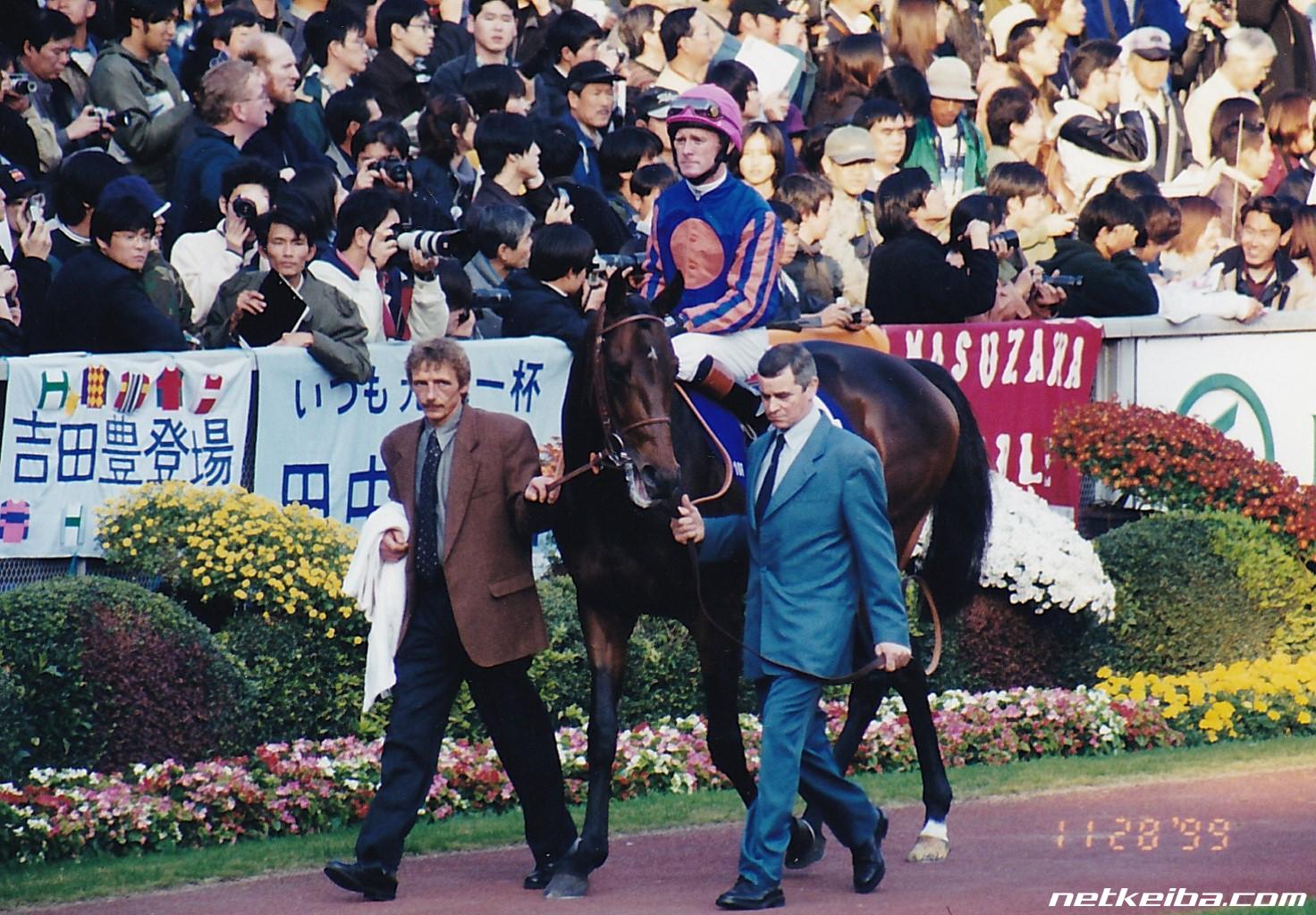
Montjeu stayed in training for 2000 rather than ending his career after his championship three-year-old season. His second senior campaign produced another group of major wins and extended his record across a range of top European middle- and long-distance turf events.
The Tattersalls Gold Cup was among Montjeu’s principal victories at four. Its inclusion in his 2000 campaign showed his effectiveness at a shorter middle-distance test than the 2,400-metre races that featured prominently elsewhere in his record.
He subsequently won the Grand Prix de Saint-Cloud, restoring the emphasis to a longer championship distance. That success was especially consistent with his wider profile: a horse capable of competing at the top level across the middle- to long-distance range rather than being confined to a single trip.
Montjeu’s major British victory came in the 2000 King George VI and Queen Elizabeth Stakes. Added to his French and Irish accomplishments, it made his record notably international within European racing: the Irish-bred, French-trained horse had now secured major prizes in France, Ireland and Britain.
The King George also strengthened his four-year-old campaign in its own right. He was not simply racing on after the Arc-winning season; he was still adding major championship events to his résumé. Together with the Tattersalls Gold Cup and Grand Prix de Saint-Cloud, it gave him three headline victories during 2000.
Montjeu continued racing into the autumn of 2000, with Michael Kinane riding him in each of four documented late-season starts. He won the Group 2 Prix Foy over 2,400 metres on turf on 10 September, a result that provided a successful lead-in to his attempt to repeat the previous year’s Arc victory.
On 1 October he returned to the 2,400-metre Prix de l’Arc de Triomphe but finished fourth. The result ended his bid to win the race in consecutive years, although it came after a season in which he had already collected the Tattersalls Gold Cup, Grand Prix de Saint-Cloud and King George VI and Queen Elizabeth Stakes.
Only 13 days after the Arc, Montjeu dropped to 2,000 metres for the Group 1 Dubai Champion Stakes. He finished second, adding another top-two result at the highest level and underlining the breadth of distance represented in his four-year-old campaign.
His final documented appearance came in the United States in the Breeders’ Cup Turf on 4 November. Returned to 2,400 metres, he finished seventh. That closing sequence—from victory in the Prix Foy to fourth in the Arc, second in the Champion Stakes and seventh in the Breeders’ Cup Turf—did not match the uninterrupted major-race success of his peak, but it reflected an ambitious final autumn across France, Britain and the United States.
John Hammond trained Montjeu throughout his career from Chantilly. That French base shaped the programme around which his record was built, including two campaigns centred on the Prix de l’Arc de Triomphe and victories in the Prix du Jockey Club, Grand Prix de Saint-Cloud and Prix Foy.
At the same time, Montjeu’s achievements were not limited to France. His Irish Derby and Tattersalls Gold Cup victories gave him major Irish successes, while the King George VI and Queen Elizabeth Stakes supplied a defining British win. His last start took him to the Breeders’ Cup Turf in the United States.
His record shows a horse primarily associated with turf competition from 2,000 to 2,400 metres. The 2000 autumn alone included starts over both distances, while his principal career victories ranged from middle-distance events to 2,400-metre championships. That versatility was an important part of his racing identity, allowing his connections to pursue both major European summer prizes and the leading autumn contests.
Montjeu retired with 11 victories from 16 appearances, having won six major races across his three- and four-year-old seasons. His 1999 campaign remains the clearest summary of his competitive stature: the Prix du Jockey Club, Irish Derby and Prix de l’Arc de Triomphe, followed by recognition as Cartier Three-Year-Old Colt.
His four-year-old season added depth to that record. The Tattersalls Gold Cup demonstrated his effectiveness over a shorter middle distance, while the Grand Prix de Saint-Cloud and King George VI and Queen Elizabeth Stakes reaffirmed his standing over longer trips. These achievements established a career spanning multiple countries, distances and generations of opposition.
After racing, Montjeu became a sire. His pedigree—by Sadler’s Wells out of the Top Ville mare Floripedes—therefore continued to influence the Thoroughbred population beyond his own time on the racecourse. He died on 29 March 2012, aged 15.
| Date | Race | Grade | Course | Going | Dist | Pos | Draw | Jockey | Wgt | SP | Time |
|---|---|---|---|---|---|---|---|---|---|---|---|
| 2000-11-04 |
Breeders' Cup Turf
|
G1 | Usa (JP) | Good | 2400 m | 7 | 4 | Michael Kinane | 58.0 kg | 0.0 | - |
| 2000-10-14 |
Dubai Champion Stakes Class A (Group 1)
|
G1 | Newmarket (JP) | Good to Soft | 2000 m | 2 | 7 | Michael Kinane | 58.0 kg | 0.0 | - |
| 2000-10-01 |
PRIX DE L'ARC DE TRIOMPHE LUCIEN BARRIERE
|
G1 | Longchamp (JP) | Good | 2400 m | 4 | 2 | Michael Kinane | 59.5 kg | 0.0 | - |
| 2000-09-10 |
PRIX FOY GRAY D'ALBION BARRIERE
|
G2 | Longchamp (JP) | Good | 2400 m | 1 | 3 | Michael Kinane | 58.0 kg | 0.0 | 2:32.80 |
| 2000-07-29 |
King George VI and Queen Elizabeth Stakes
|
G1 | Uk (JP) | Good | 2400 m | 1 | 5 | Michael Kinane | 60.5 kg | 0.0 | 2:29.98 |
| 2000-07-02 |
GRAND PRIX DE SAINT-CLOUD
|
G1 | Saint-Cloud (JP) | Good | 2400 m | 1 | 2 | C.Asmussen | 61.0 kg | 0.0 | 2:31.40 |
| 2000-05-28 |
Tattersalls Gold Cup (Group 1)
|
G1 | Curragh (JP) | Good to Soft | 2100 m | 1 | 3 | Michael Kinane | 57.0 kg | 0.0 | 2:13.30 |
| 1999-11-28 |
JAPAN CUP
|
G1 | Tokyo (JP) | Good | 2400 m | 4 | 14 | Michael Kinane | 55.0 kg | 2.7 | 2:25.8 |
| 1999-10-03 |
PRIX DE L'ARC DE TRIOMPHE LUCIEN BARRIERE
|
G1 | Longchamp (JP) | Heavy | 2400 m | 1 | 1 | Michael Kinane | 56.0 kg | 0.0 | 2:38.5 |
| 1999-09-12 |
PRIX NIEL
|
G2 | Longchamp (JP) | Good | 2400 m | 1 | 2 | Michael Kinane | 58.0 kg | 0.0 | 2:32.80 |
| 1999-06-27 |
Budweiser Irish Derby (Group 1)
|
G1 | Curragh (JP) | Good | 2400 m | 1 | 5 | C.Asmussen | 57.0 kg | 0.0 | 2:30.10 |
| 1999-06-06 |
Emirates Airline Prix du Jockey Club (Group 1) (Colts & Fillies)
|
G1 | Chantilly (JP) | Soft | 2400 m | 1 | 8 | C.Asmussen | 58.0 kg | 0.0 | 2:33.50 |
| 1999-05-16 |
PRIX LUPIN
|
G1 | Longchamp (JP) | Good | 2100 m | 2 | 4 | C.Asmussen | 58.0 kg | 0.0 | - |
| 1999-04-25 |
PRIX GREFFULHE
|
G2 | Longchamp (JP) | Soft | 2100 m | 1 | 6 | C.Asmussen | 58.0 kg | 0.0 | 2:20.10 |
| 1998-10-18 |
PRIX ISONOMY
|
OP | Longchamp (JP) | Heavy | 1800 m | 1 | 3 | C.Asmussen | 56.0 kg | 0.0 | 2:01.70 |
| 1998-09-18 |
PRIX DE LA MANIGUETTE
|
- | Chantilly (JP) | Good to Soft | 1600 m | 1 | 9 | C.Asmussen | 54.5 kg | 0.0 | 1:42.80 |
Citations
Imported and enriched race results from supported racing sources.